Proactive cyber defence: your complete 2026 guide
Proactive cyber defence is defined as a preemptive cybersecurity strategy that identifies, anticipates, and neutralises threats before they cause harm. Where traditional security waits for an alarm to sound, proactive defence hunts for weaknesses before attackers find them. The threat environment has shifted dramatically. Adversaries now move faster than human response teams can manage, using automation to compress attack timelines from days to minutes. Frameworks like NIS2 and DORA now require organisations to demonstrate that their security controls actually work against real threats, not just that the controls exist. Understanding what is proactive cyber defence, and why it matters, is the first step toward genuine digital resilience.
What is proactive cyber defence and why does it matter?
Proactive cybersecurity is a preemptive strategy focused on identifying, anticipating, and neutralising threats before they manifest. That distinction is more significant than it sounds. Reactive security is like fixing a broken lock after a burglary. Proactive defence is fitting better locks, installing cameras, and checking for signs of tampering every week.
The urgency here is real. Threat actors increasingly use automation to scan for exposed systems, exploit vulnerabilities, and move laterally through networks at machine speed. Human analysts responding after the fact simply cannot keep pace. Proactive strategies close that gap by removing vulnerabilities and hardening systems before attackers arrive.

Regulatory pressure reinforces this shift. NIS2 and DORA require organisations to not only implement security controls but also demonstrate their effectiveness against real threats. Compliance is no longer a checkbox exercise. It demands evidence that your defences hold up under realistic attack conditions.
What are the core strategies behind proactive security?
Core proactive techniques include continuous attack surface monitoring, threat intelligence integration, regular security validation, and privilege management. Each addresses a different angle of the same problem: reducing the opportunities attackers have to succeed.
Continuous attack surface monitoring maps every digital asset an organisation exposes to the internet, including cloud services, APIs, and remote access points. Unmanaged assets are a favourite entry point for attackers, so visibility is the foundation of everything else.
Threat intelligence integration means feeding current data about adversary tactics, techniques, and procedures into your security operations. This lets you anticipate which attack methods are trending and prioritise defences accordingly, rather than guarding against last year’s threats.
Security validation through penetration testing and automated red teaming checks whether your controls actually stop attacks. Running these exercises regularly reveals gaps that vulnerability scans alone miss.
Privilege and identity management limits what any single account or system can access. Attackers who compromise one credential should find themselves in a walled garden, not a corridor with open doors to every system.
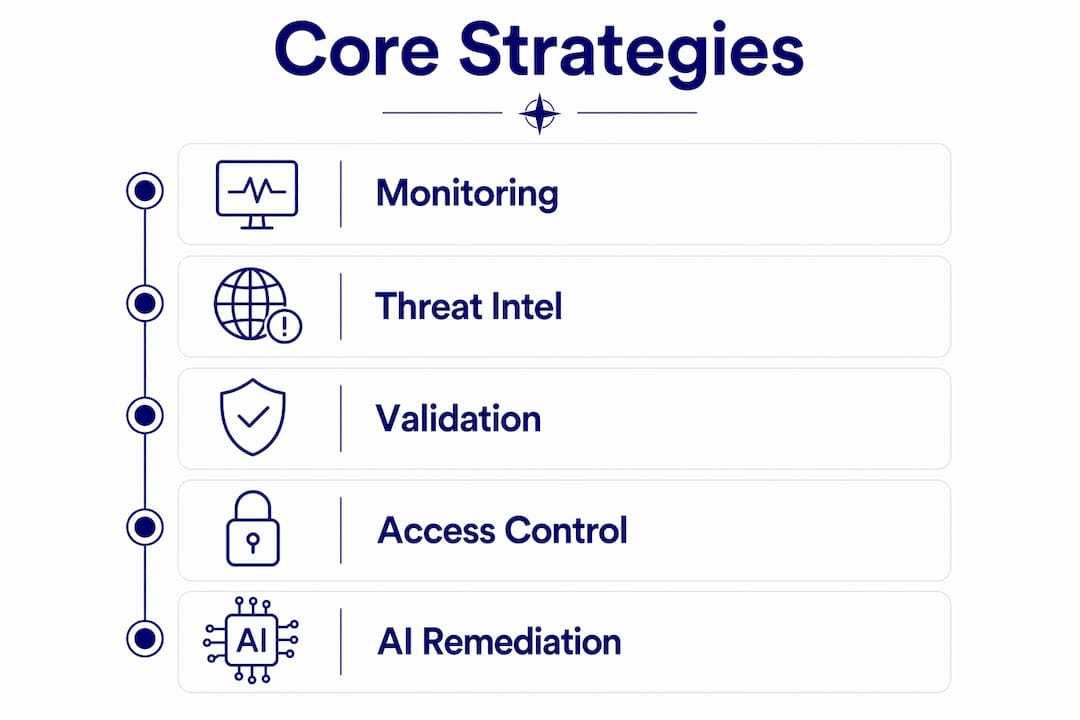
Agentic AI now automates remediation at a scale that manual processes cannot match. AI-powered tools prioritise exposures by business impact and actual attack paths, not just severity scores. That distinction matters enormously in practice.
Reactive approach | Proactive approach |
Responds after a breach occurs | Identifies and removes threats before impact |
Patches known vulnerabilities on a schedule | Continuously monitors for new exposures |
Alert-driven, high volume, low context | Attack path prioritisation by business risk |
Relies on human speed | Scales with AI-powered automation |
Compliance as a snapshot | Compliance as ongoing demonstrated effectiveness |
Pro Tip: Do not measure your proactive programme by how many scans you run. Measure it by how many confirmed attack paths you close each month. Volume without prioritisation creates alert fatigue, not security.
How does proactive cyber defence differ from reactive cybersecurity?
Reactive cybersecurity responds after incidents occur, focusing on containment, recovery, and patching. Proactive security prevents those incidents from happening in the first place. The difference is not just philosophical. It has direct consequences for cost, downtime, and reputation.
Reactive models struggle in fast, automated threat environments. By the time an alert fires and a human analyst investigates, an attacker using automated lateral movement tools may have already reached sensitive data. The reactive model was designed for a slower era of threats.
Proactive approaches reduce costs by catching vulnerabilities before they become breaches. A breach carries direct costs in incident response, legal liability, regulatory fines, and customer notification, plus indirect costs in lost business and damaged trust. Prevention is measurably cheaper than recovery.
The advantages of proactive over reactive security are clear:
Threats are neutralised before they cause operational disruption
Security teams spend time on prevention rather than crisis management
Regulatory frameworks like NIS2 and DORA reward demonstrated proactive controls
Reduced attack surface means fewer entry points for adversaries to exploit
Stakeholder trust grows when organisations can show continuous security improvement
AI-driven attack cycles are countered by equally automated proactive defences
Reactive security still has a role. No organisation eliminates every threat. But relying on reactive measures alone is like driving without a seatbelt because you are a careful driver. The risk is not just your own skill. It is everyone else on the road.
What are the real benefits of proactive cyber defence?
Organisations adopting proactive cyber defence report stronger security posture, better operational resilience, and increased trust among clients and stakeholders. These are not abstract outcomes. They translate directly into business continuity and competitive advantage.
Compliance becomes far less painful when proactive controls are already in place. NIS2 and DORA audits require evidence of effectiveness, and organisations running continuous monitoring and validation programmes already have that evidence. They are not scrambling to produce documentation before an audit deadline.
Resource allocation improves significantly. When your team prioritises by actual business risk and attack path rather than raw vulnerability count, they spend time on what genuinely matters. That is a meaningful efficiency gain for any security team, particularly in smaller organisations where headcount is limited.
“AI-driven threats make proactive cybersecurity critical for maintaining social and economic stability and sustaining long-term innovation. Organisations that wait for incidents to act are already behind.” Forbes, march 2026
For families and schools, the benefits are equally tangible. Reducing online risks through proactive habits, like reviewing privacy settings, monitoring connected devices, and building digital awareness, produces the same protective effect at a personal scale. The principle does not change. Only the tools do.
How can organisations implement proactive cyber defence effectively?
Implementation does not require a complete security overhaul on day one. A phased, prioritised approach delivers results faster and avoids the paralysis of trying to do everything at once.
Map your attack surface. Identify every internet-facing asset, including shadow IT and cloud services your team uses without formal approval. You cannot protect what you cannot see.
Integrate threat intelligence. Subscribe to reputable threat feeds relevant to your industry and geography. Use that intelligence to update your defences before known attack methods reach your environment.
Run regular security validation. Schedule penetration tests and automated red team exercises at least quarterly. Treat the findings as a prioritised work list, not a report to file away.
Tighten privilege and identity controls. Apply the principle of least privilege across all accounts. Require multi-factor authentication on every external-facing system and privileged account without exception.
Deploy AI-powered exposure management. Use tools that prioritise vulnerabilities by business impact and confirmed attack paths. Effective exposure management uses business-risk prioritisation rather than severity scores alone, which reduces alert fatigue significantly.
Build security awareness into your culture. Technical controls fail when people are not equipped to recognise threats. Regular training, clear policies, and open conversations about digital safety are non-negotiable components of any proactive programme.
Establish external partnerships. Proactive cyber defence does not require organisations to act offensively. Working with external parties who handle adversary takedowns and threat disruption extends your reach without legal or operational risk.
For schools, embedding student cyber awareness into existing programmes is a practical starting point. For SMEs, a structured risk assessment followed by targeted controls delivers the highest return on limited budgets.
Pro Tip: The most common implementation mistake is overemphasising scanning frequency. A team that scans daily but never closes confirmed attack paths is generating noise, not security. Prioritise remediation over reporting.
Key takeaways
Proactive cyber defence is the most effective way to reduce attack impact, meet regulatory requirements, and build lasting digital resilience for organisations and individuals alike.
Point | Details |
Proactive vs reactive | Proactive defence prevents breaches; reactive security responds after harm has already occurred. |
Core techniques | Continuous monitoring, threat intelligence, security validation, and privilege management form the foundation. |
AI and automation | AI-powered tools prioritise exposures by business risk and attack path, not just vulnerability severity scores. |
Regulatory alignment | Frameworks like NIS2 and DORA require demonstrated effectiveness, which proactive programmes deliver by design. |
Culture and awareness | Technical controls alone are insufficient; security awareness training is a required component of any proactive strategy. |
Why I think most organisations are still getting this backwards
I have spent years watching organisations invest heavily in detection tools while underinvesting in prevention. The logic is understandable. Detection feels tangible. You see the alerts. You measure the response times. Prevention is harder to quantify because the metric is attacks that never happened.
Despite the term “proactive cyber” sometimes implying offensive action, most organisations should focus entirely on internal hardening and resilience. The legal and operational risks of offensive action beyond your own perimeter are real and significant. The goal is not to fight back. It is to make your environment so difficult to exploit that attackers move on.
What concerns me most right now is the speed of AI-driven threats. Automated attack tools do not sleep, do not take weekends off, and do not need a team of people to operate. A proactive programme that relies on quarterly reviews and annual penetration tests is already running behind. Continuous is not a buzzword here. It is a genuine requirement.
The organisations I see doing this well share one trait: they treat security as a behaviour, not a product. They build awareness into daily routines, they test their assumptions regularly, and they collaborate with external experts rather than assuming internal teams can handle everything alone. That combination of culture, process, and technology is what actually works.
— Jemma
How Cybercompassconsulting supports your proactive security approach
Cybercompassconsulting works with families, schools, SMEs, and corporate teams to build evidence-based cyber wellness plans grounded in behavioural science and practical security. The approach goes beyond compliance checklists to develop genuine awareness, resilience, and proactive digital habits across your entire organisation or household.
Whether you are an SME looking to strengthen your business security or a school community building digital safety culture from the ground up, Cybercompassconsulting offers tailored programmes and ongoing support. The Build a Cyber Wellness Plan service creates a customised, proactive strategy matched to your specific risk profile, sector, and resources. With over 35 years of experience connecting technology and human behaviour, Cybercompassconsulting helps you move from reactive worry to confident, informed defence.
FAQ
What is proactive cyber defence in simple terms?
Proactive cyber defence is a security approach that identifies and removes threats before they cause harm, rather than responding after a breach has occurred. It uses continuous monitoring, threat intelligence, and security testing to stay ahead of attackers.
How does proactive cyber defence differ from traditional security?
Traditional security is largely reactive, responding to incidents after they happen. Proactive defence anticipates threats, closes vulnerabilities in advance, and continuously validates that controls are working against real attack methods.
Is proactive cyber defence only for large organisations?
Proactive defence applies to any organisation or individual with digital assets to protect, including SMEs, schools, and families. The scale of implementation differs, but the core principles of monitoring, awareness, and prevention apply universally.
What role does AI play in proactive cybersecurity?
AI automates the prioritisation and remediation of exposures at a scale that manual processes cannot match. It identifies confirmed attack paths and ranks them by business impact, helping security teams focus effort where it matters most.
Do proactive cyber defence strategies require offensive action?
No. Most organisations focus strictly on internal hardening, resilience, and collaboration with external security partners. Offensive action beyond your own perimeter carries significant legal and operational risk and is not required for effective proactive defence.
Recommended
Comments