The role of leadership in digital safety: 2026 guide
Leadership in digital safety is defined as the executive responsibility to own organisational cyber risk, set security priorities, and build a culture where safe digital behaviour is the norm. This is not a task you can hand off to your IT team and forget. CISOs face a 1 in 4 chance of losing their jobs after a major cyberattack. That statistic tells you everything about where accountability sits. The role of leadership in digital safety is to make the hard calls about risk, communicate them clearly, and model the behaviours you expect from every person in your organisation.
How does leadership impact digital safety outcomes?
Leadership quality directly shapes how well an organisation withstands cyber threats. A 2026 study published in ScienceDirect found that higher managerial ability reduces cybersecurity breach risk by embedding security into governance and internal controls. That is not a coincidence. Managers with strong judgement allocate resources to the right risks, rather than spreading protection thinly across every possible threat.
The connection between leadership style and security outcomes runs deeper than most executives realise. Leaders who treat cybersecurity as a governance matter, not a technical project, integrate it into risk management frameworks, board reporting, and business planning. This shifts security from a reactive cost centre to a proactive business function.

ISC2 research from 2026 shows that 71% of cybersecurity professionals prefer leaders who balance technical depth with strategic executive experience. Only 11% want a purely hands-on technical background. Your teams are telling you they need someone who can translate risk into business language and make decisions under pressure, not just someone who understands firewalls.
What leadership traits matter most for digital security?
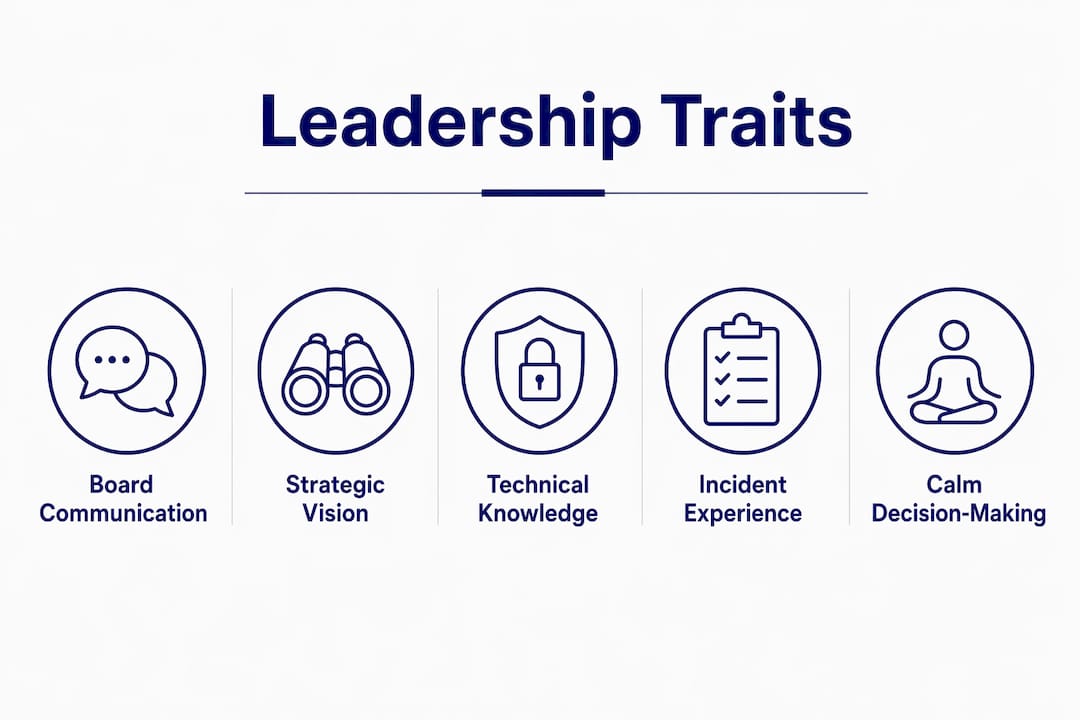
The traits that cybersecurity teams value most are not what many executives expect. Communication to boards ranks at 95% as a critical leadership quality, followed by strategic vision at 91% and transparency at 86%. These are governance and communication skills, not technical ones. A leader who can explain a breach to a board calmly and clearly is worth more to an organisation than one who can configure a network.
Experience during a real incident also matters enormously. 76% of cybersecurity professionals agree that a leader who has navigated a major incident earns greater credibility and trust. That credibility translates directly into calmer, more effective responses when the next incident hits.
Pro Tip: If you have not yet experienced a significant cyber incident, run a tabletop exercise with your leadership team. Simulating a breach response builds the muscle memory your team needs before a real crisis arrives.
Leadership quality | Why it matters for digital safety |
Board-level communication | Keeps governance informed and enables faster resource decisions during incidents |
Strategic vision | Aligns security investments with business priorities rather than technical preferences |
Transparency | Builds staff trust and encourages reporting of suspicious activity |
Calm decision-making | Reduces panic-driven errors during active incidents |
Incident experience | Proven credibility under pressure improves team confidence and response quality |
Is cybersecurity really a leadership problem, not an IT problem?
Cybersecurity is a leadership responsibility that IT teams execute. The distinction matters. Leadership defines the “how much” and “why” of cybersecurity risk. IT defines the “how.” When leaders abdicate that responsibility, IT teams are left guessing what the business actually values and which risks are acceptable.
The consequences of that gap are predictable. IT teams protect everything equally because no one has told them what matters most. Resources get wasted on low-priority systems while critical data sits underprotected. Worse, staff receive no clear signal from the top about how seriously the organisation takes digital safety, so they treat it as someone else’s problem too.
The misconception that cybersecurity is purely technical persists because it feels comfortable. Technical problems have technical solutions. But cybersecurity requires top-down culture, training, operational habits, and risk discipline. None of those come from a software vendor. They come from you.
Common signs that leadership has abdicated digital safety responsibility include:
Security budgets decided by IT without executive input on business risk priorities
No documented risk appetite statement that guides security investment decisions
Training programmes that run once a year and are never reinforced by leadership behaviour
Incident response plans that exist on paper but have never been tested by the leadership team
A culture where staff fear reporting mistakes rather than feeling safe to flag them
Pro Tip: Ask your IT team what your organisation’s top three cyber risks are. Then ask your board the same question. If the answers differ significantly, your leadership team has work to do on risk communication.
Practical ways leaders can build a digital safety culture
Building a genuine culture of digital safety starts with visible, consistent leadership behaviour. Your teams watch what you do far more closely than they listen to what you say. If you skip security training, use weak passwords, or dismiss incident reports as overblown, your staff will follow that lead.
The most effective leaders take these steps to embed digital safety across their organisations:
Define and communicate your risk appetite. Write it down. Share it with your board, your IT team, and your department heads. A clear risk appetite statement tells everyone which assets matter most and how much risk the organisation is willing to accept.
Model the behaviour you expect. Complete security training yourself. Use multi-factor authentication. Report phishing attempts. When staff see executives taking these steps seriously, the behaviour spreads.
Integrate security into business planning. Every major project, product launch, or operational change should include a security review. This makes digital safety a standard part of how your organisation works, not an afterthought.
Run regular, realistic training. Annual compliance tick-boxes do not change behaviour. Short, frequent, scenario-based training sessions do. Leaders who champion employee cyber hygiene practices see measurable improvements in staff awareness over time.
Create psychological safety around reporting. Staff who fear blame will hide mistakes. Leaders who respond to reported incidents with curiosity rather than punishment build organisations that catch threats early.
Review and improve continuously. After every incident or near-miss, hold a structured review. What worked? What failed? What changes will you make? This feedback loop is what separates organisations that learn from those that repeat the same mistakes.
Calm decision-making during incidents is a skill, not a personality trait. Leaders who practise it through simulation and reflection build organisations that respond to crises with clarity rather than panic. The role of digital habits in shaping that culture is significant and often underestimated.
How does digital safety leadership connect to governance and business goals?
Digital safety leadership is not separate from organisational governance. It is a core part of it. Boards and executives who treat cybersecurity as a governance matter, alongside financial risk and regulatory compliance, build organisations that are genuinely resilient.
Collaboration and education are as critical to cyber resilience as technology. That insight reframes the entire conversation. Resilience is not something you buy. It is something you build through relationships, training, and consistent leadership over time.
Organisations with mature digital safety leadership integrate security into business continuity planning, reputation management, and regulatory compliance. They do not treat a breach as a purely technical event. They treat it as a business event that requires executive communication, stakeholder management, and operational recovery.
The table below clarifies where leadership responsibility ends and IT operational responsibility begins.
Responsibility area | Leadership role | IT operational role |
Risk appetite | Define acceptable risk levels and business priorities | Implement controls aligned to defined risk levels |
Security investment | Approve budgets based on business risk | Recommend technical solutions within approved budgets |
Incident response | Communicate with board, stakeholders, and media | Contain, investigate, and remediate the technical breach |
Training and culture | Champion and model safe behaviour | Deliver technical training content and tools |
Regulatory compliance | Own accountability for compliance outcomes | Implement technical controls that satisfy requirements |
When these roles are clearly defined, organisations stop wasting time on internal confusion during a crisis. Leaders lead. IT executes. Everyone knows their part. That clarity is itself a form of digital safety governance that reduces risk.
Key takeaways
Leadership in digital safety is the single most powerful lever an organisation has for reducing cyber risk and building lasting resilience.
Point | Details |
Leadership owns the risk | Executives must define risk appetite and security priorities, not delegate them entirely to IT. |
Managerial ability reduces breaches | Higher-ability managers embed security into governance, directly lowering breach frequency. |
Balanced skills are preferred | 71% of cybersecurity professionals want leaders who combine technical understanding with executive communication. |
Culture beats compliance | Top-down behaviour modelling, transparent communication, and psychological safety drive real security culture. |
Governance alignment matters | Integrating digital safety into board-level governance connects security to business continuity and reputation. |
Why I think most organisations are still getting this wrong
I have worked with enough organisations to see the same pattern repeat itself. Leadership signs off on a security budget, delegates everything to IT, and then expresses genuine surprise when a breach happens. The surprise is the tell. It means they were never really engaged.
The uncomfortable truth is that most leaders treat cybersecurity the way they treat insurance. They want it to exist, they do not want to think about it, and they assume someone else is handling the details. That mindset is exactly what attackers count on.
What I have seen actually work is when a senior leader, often after a near-miss or a breach at a peer organisation, decides to get genuinely curious. They start asking their IT team hard questions. They sit in on training sessions. They talk openly about a phishing email they almost clicked. That visible vulnerability from the top changes the entire culture of an organisation faster than any policy document ever could.
The importance of leadership in digital safety is not just about governance frameworks or risk registers. It is about whether your people believe that safety matters to the people in charge. When they do, they act accordingly. When they do not, no amount of technology will save you.
If you are a leader reading this and feeling uncertain about where to start, that uncertainty is actually a good sign. It means you are taking the question seriously. Start with one honest conversation with your IT team about what they wish you understood. The answers will surprise you.
— Jemma
How Cybercompassconsulting helps leaders build digital safety culture
Cybercompassconsulting works with organisational leaders who know that cybersecurity is their responsibility but are not sure where to start. The approach goes beyond compliance checklists to address the behavioural and cultural dimensions of digital safety that technical tools cannot fix.
Programmes are tailored for SME business leaders and corporate teams, covering leadership training, cyber wellness planning, and culture development. With over 35 years of experience integrating behavioural science with practical security strategies, Cybercompassconsulting helps executives build the kind of visible, engaged leadership that actually changes how organisations behave. If you are ready to move from delegation to ownership, explore the full range of services and find the right starting point for your organisation.
FAQ
What is the role of leadership in digital safety?
Leadership in digital safety means owning organisational cyber risk, defining risk appetite, and building a culture of safe digital behaviour from the top down. Leaders set the priorities that IT teams then execute.
How do leaders impact digital security outcomes?
Higher managerial ability directly reduces cybersecurity breach risk by embedding security into governance and resource allocation. Leaders who engage actively with security decisions produce measurably better outcomes than those who delegate entirely.
What skills do cybersecurity leaders need most?
Board-level communication, strategic vision, and transparency rank as the top three qualities cybersecurity professionals value in leaders. Technical depth matters, but the ability to translate risk into business language matters more.
Why is cybersecurity not just an IT problem?
Cybersecurity requires culture, training, and risk discipline that only leadership can drive. When executives abdicate responsibility, IT teams are left guessing business priorities, which leads to misaligned protection and wasted resources.
How can leaders build a culture of digital safety?
Leaders build digital safety culture by modelling safe behaviour, defining clear risk appetite, running frequent scenario-based training, and creating psychological safety around reporting mistakes. Consistency over time is what makes the culture stick.
Recommended
Comments