The role of empathy in cyber wellness: 2026 guide
- jemmarenshaw
- 11 hours ago
- 7 min read
Empathy in cyber wellness is the active practice of understanding and sharing the feelings of others online, and it directly shapes how safe, respectful, and accountable our digital spaces become. Research confirms that cyber wellness differs from cyber safety by prioritising emotional regulation and ethical conduct, not just technical security measures. The role of empathy in cyber wellness is not a soft add-on to digital safety. It is the foundation that determines whether people treat each other with care or cruelty when screens remove the human face from the conversation. Cybercompassconsulting has spent over 35 years working with families, schools, and organisations on exactly this challenge.
How does empathy shape cyberbullying and online aggression?
The evidence is clear and worth sitting with. A longitudinal study of 698 adolescents aged 12–18, followed over one year, found that higher online empathy predicts lower future engagement in cyberbullying. That single finding reframes the entire conversation: empathy is not just a nice quality to have online. It is a measurable protective factor.

The same research draws an important distinction between cyberbullying and cyberhate. Moral disengagement, not low empathy, is the stronger predictor of cyberhate. This matters because the two problems call for different responses. Reducing cyberbullying requires building empathy. Reducing cyberhate requires addressing the moral reasoning that allows people to dehumanise others at scale.
What does this look like in practice? A teenager who can genuinely imagine how a classmate feels after a humiliating post is far less likely to share it. That imaginative act, putting yourself in someone else’s position before you click, is the core mechanism. Without it, the speed and anonymity of digital communication make cruelty effortless.
Empathy as a buffer: Young people with higher online empathy are less likely to initiate or participate in cyberbullying incidents, even when provoked.
Moral disengagement as a separate risk: Cyberhate thrives when people convince themselves that targets are not fully human or deserving of respect.
Context shapes expression: Empathy online is multidimensional and relational, meaning its effectiveness depends on the platform, the relationship, and how it is expressed.
Pro Tip: When you witness a hostile exchange online, pause before responding or sharing. Ask yourself: “Would I say this if I could see this person’s face?” That pause is empathy in action.
Why doesn’t empathy always lead to helping online?
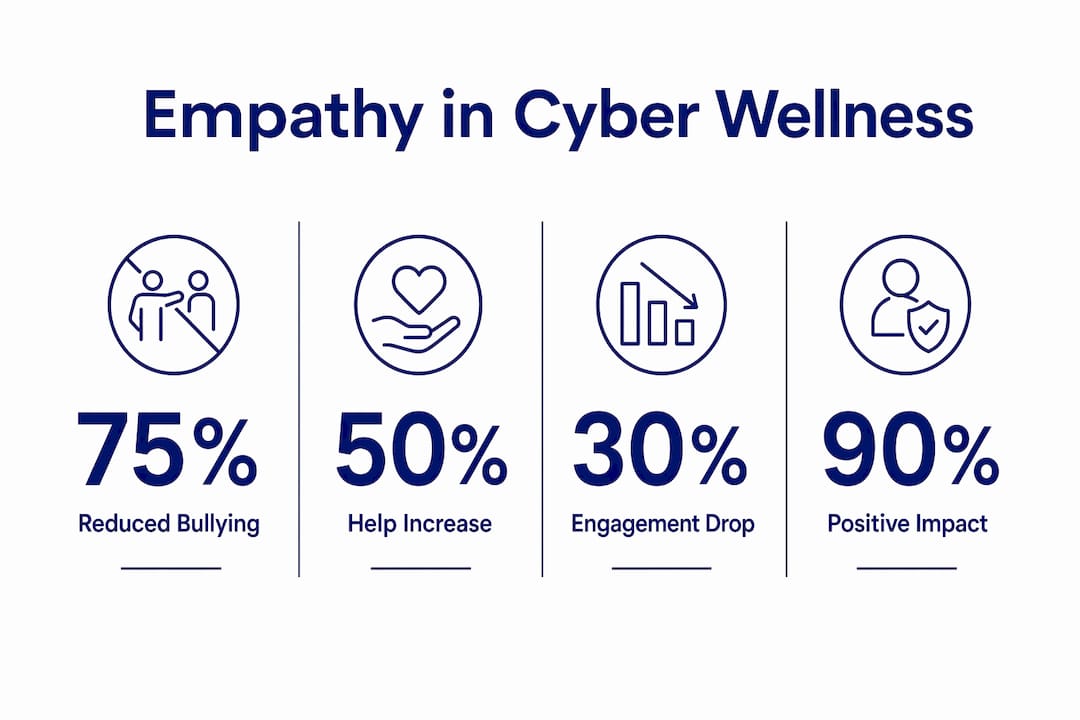
This is where the research gets genuinely surprising. You might assume that an empathetic bystander always steps in to help a cyberbullying victim. Studies with undergraduates show that high accuracy motivation attenuates the positive relationship between empathy and helping behaviour. In plain terms: when bystanders focus too hard on verifying whether something is “really” bullying before acting, they delay or abandon helping altogether.
This is a trap worth naming. The instinct to check the facts before intervening feels responsible. But in a fast-moving online incident, over-verification becomes a reason to do nothing. The victim waits. The harm compounds.
Balancing discernment with timely compassion is the skill that most digital safety programmes overlook. Here is a practical framework for bystanders navigating this tension:
Acknowledge first. Send a private message to the person being targeted. You do not need to have all the facts to say, “I saw what happened and I’m sorry you’re going through this.”
Report in parallel. Use platform reporting tools while you reach out. These actions are not mutually exclusive.
Seek context after, not before. Gather more information once the immediate harm is addressed, not as a prerequisite for acting.
Avoid public adjudication. Wading into a public thread to “fact-check” an incident often escalates rather than resolves it.
The lesson is not that accuracy is unimportant. The lesson is that compassionate assistance and careful verification can happen simultaneously, and that delaying one for the other costs real people real harm.
What strategies promote empathy to strengthen digital communities?
Building empathy online does not happen by accident. A systematic review of communication interventions published in 2026 identified three types of approaches that reliably increase digital empathy: engaging with opposing views, building positive social connections, and encouraging reflection and accountability.
These strategies differ meaningfully from traditional cyber safety approaches, which tend to focus on blocking, filtering, and reporting. Cyber wellness strategies that centre empathy ask a harder question: how do we help people want to treat each other well, not just comply with rules?
Engaging with opposing views: Structured exposure to perspectives different from your own, done in a psychologically safe environment, reduces the “othering” that fuels online hostility. This is not about agreeing. It is about recognising the person behind the opinion.
Building positive social connections: Communities with strong relational bonds show lower rates of online aggression. Digital citizenship programmes that prioritise belonging, not just rules, build this kind of culture.
Reflection and accountability: Prompting people to review their own online behaviour, through journalling, peer feedback, or structured check-ins, builds the self-awareness that empathy requires.
Pro Tip: In workplace settings, try a monthly “digital tone review” where team members reflect on one online interaction they handled well and one they would approach differently. This builds empathetic habits without blame.
The table below contrasts empathy-centred cyber wellness strategies with conventional cyber safety approaches:
Focus area | Cyber safety approach | Empathy-centred cyber wellness |
Goal | Prevent harm through rules | Build culture of care and respect |
Method | Blocking, filtering, reporting | Reflection, connection, perspective-taking |
Outcome measure | Incident reduction | Emotional well-being and relational quality |
Who leads | IT or compliance teams | Educators, counsellors, community leaders |
How do you apply empathy in everyday digital habits?
Cyber wellness behaviour is best understood as a continuous development path, not a fixed state you reach and maintain. This framing matters because it removes the pressure to be perfect online and replaces it with a commitment to keep growing. Your digital habits in a professional Slack channel require different empathetic skills than those in a family group chat or a public forum.
Digital self-care is itself an empathetic practice. Curating your feeds and scheduling breaks protects your own emotional reserves, which directly affects your capacity to respond to others with patience and care. You cannot pour from an empty cup, and chronic technostress makes empathetic responses genuinely harder to produce.
Practical empathetic digital habits include:
Setting response boundaries: Not every message requires an immediate reply. Communicating your availability reduces misunderstandings and models healthy digital behaviour for others.
Using explicit emotional language: Without non-verbal cues, tone is easily misread. Phrases like “I appreciate you raising this” or “I can see this is frustrating” do the work that a facial expression would do in person.
Pausing before posting: A brief delay before sending a charged message reduces reactive communication. Many platforms now offer a “take a moment” prompt for this reason.
Checking in, not just checking up: In professional settings, asking “How are you finding the workload this week?” signals care. It is different from monitoring performance.
The link between empathy, cyber wellness, and resilience against online toxicity is direct. People who practise empathetic digital habits report greater emotional stability online and are less reactive to provocative content. That stability is not passivity. It is the foundation of thoughtful, safe digital participation.
Key takeaways
Empathy is the single most underused protective factor in cyber wellness, and building it deliberately produces measurable reductions in online harm.
Point | Details |
Empathy reduces cyberbullying | Longitudinal research shows higher online empathy predicts lower future cyberbullying in adolescents. |
Accuracy motivation can delay help | Over-verifying before acting reduces empathetic helping; acknowledge first, investigate in parallel. |
Three proven strategies exist | Engaging opposing views, building social connection, and encouraging reflection all increase digital empathy. |
Digital self-care enables empathy | Protecting your own mental health online preserves the emotional capacity needed to treat others well. |
Cyber wellness is continuous growth | Empathetic digital behaviour develops over time and varies by context, platform, and relationship. |
Why I think we’ve been teaching empathy online the wrong way
Social media environments cause what researchers call “moral deskilling” by stripping away the non-verbal cues that trigger automatic empathy in face-to-face settings. We lose the flinch, the hesitation, the look of hurt. And without those signals, our empathetic instincts simply do not fire the way they should.
What troubles me most is that we keep responding to this problem with rules. Block the bully. Report the post. Install the filter. These are necessary tools, but they do not rebuild what the digital environment has quietly dismantled. We need to consciously teach people to compensate for what the screen removes, using explicit language, deliberate pauses, and what researchers call meta-communication: naming the emotional register of a conversation before diving into content.
I have seen this work in school programmes and corporate teams alike. When people are given permission and language to say “I want to make sure I’m understanding you correctly before I respond,” the quality of online interaction changes. Not overnight. But steadily. The difficulty is that this kind of empathy cultivation requires ongoing effort. It is not a one-day workshop outcome. It is a practice, and like any practice, it atrophies without regular attention.
The most honest thing I can say is this: cyber psychology tells us that empathy online must be actively scaffolded, not assumed. The organisations and families that accept this and build it into their daily digital culture are the ones I see thriving. The ones waiting for technology to solve a human problem are still waiting.
— Jemma
How Cybercompassconsulting can help you build empathy-driven digital culture
Cybercompassconsulting works with schools, SME businesses, and corporate teams to embed empathy and behavioural science into everyday digital safety practice. The approach goes well beyond compliance checklists.
Whether you are a parent concerned about your child’s online interactions, a school leader wanting to build a cyber wellness school programme, or a business looking to reduce human error and technostress across your team, Cybercompassconsulting offers tailored consultations and structured planning. The Build a Cyber Wellness Plan service creates a personalised roadmap grounded in evidence and adapted to your specific context. With over 35 years of experience, the team brings both the research and the practical tools to make empathy a real part of your digital culture.
FAQ
What is the role of empathy in cyber wellness?
Empathy in cyber wellness is the practice of understanding others’ feelings online, which reduces harmful behaviour and supports emotional well-being in digital spaces. Research shows it is a measurable protective factor against cyberbullying.
How does empathy reduce cyberbullying?
A longitudinal study of 698 adolescents found that higher online empathy directly predicts lower future engagement in cyberbullying. The ability to imagine another person’s distress before acting is the core mechanism.
Can too much focus on accuracy reduce empathetic helping online?
Yes. Studies show that bystanders who prioritise verifying facts before intervening are less likely to help cyberbullying victims promptly. Acknowledging the person first, then investigating, produces better outcomes.
What is the difference between cyber wellness and cyber safety?
Cyber safety focuses on preventing harm through technical controls like blocking and filtering. Cyber wellness addresses emotional regulation, ethical conduct, and mental health as equally important components of digital well-being.
How can I practise empathy in my everyday digital habits?
Use explicit emotional language in written communication, set clear response boundaries, pause before sending charged messages, and schedule regular breaks from screens to protect your emotional reserves.
Recommended