Cyber safety workflow for HR: 2026 guide
A cyber safety workflow for HR is a structured set of policies, processes, and training activities that enables HR teams to protect employee data, manage access rights, and coordinate incident response across the organisation. Most data breaches trace back to human error, and HR sits at the centre of that risk. Under GDPR, HR teams must respond to Employee Data Subject Access Requests within one month, and qualifying breaches must be reported to authorities within 72 hours of discovery. The NIS2 Directive adds another layer, requiring continuous cybersecurity training for staff and dedicated training for management boards. Tools like Grove HR support compliance by automating workflow steps and maintaining audit trails. Getting this right is not optional.

What are the essential components of a cyber safety workflow for HR?
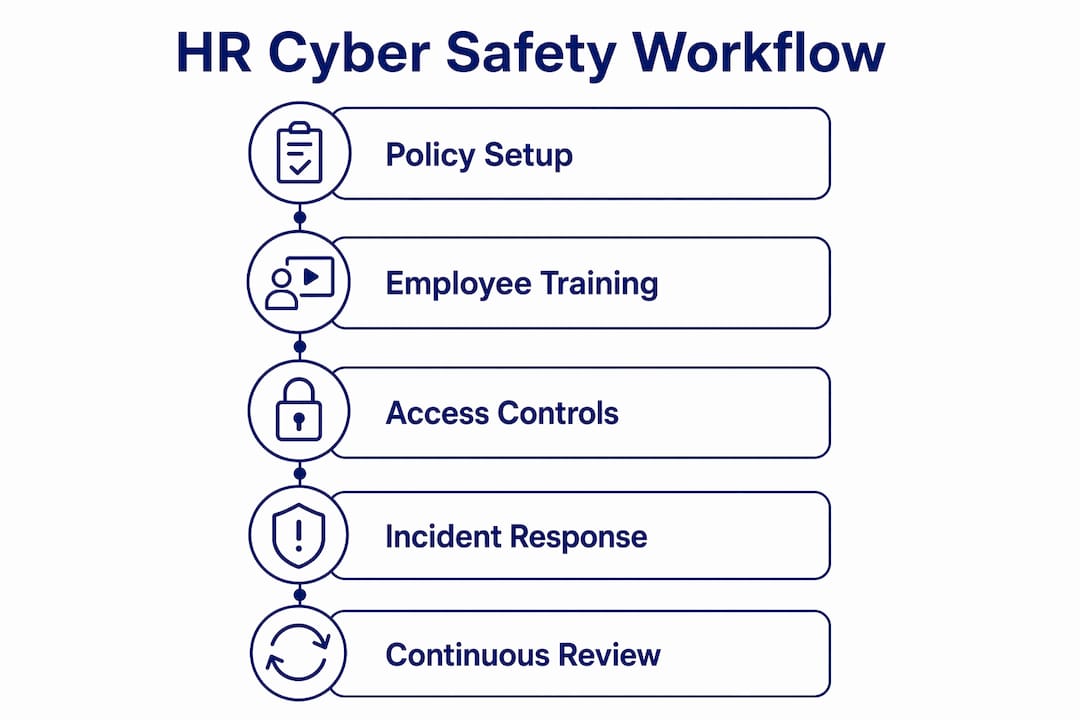
An effective HR cybersecurity workflow rests on five core building blocks. Each one addresses a different failure point, and skipping any one of them leaves the organisation exposed.
Role-based access control (RBAC) and data minimisation. Secure HRIS systems employ role-based access control, strong authentication including MFA and SSO, encryption, and detailed audit trails. Only the people who need access to sensitive employee records should have it, and only for as long as they need it.
Structured onboarding and offboarding workflows. Security-relevant departures require a same-day deprovisioning SLA. Voluntary departures require a 24-hour SLA, and both must be documented with timestamps and audited for compliance. Offboarding is where most organisations leak access credentials without realising it.
Mandatory cybersecurity training schedules. The NIS2 Directive mandates continuous training with an annual minimum, plus additional modules after incidents or major policy changes. Management board members must complete dedicated training to assess cyber risks effectively.
Audit trails and incident reporting workflows. Every sensitive action in your HRIS must be logged. Breach notification timelines under GDPR are unforgiving, so your incident reporting path needs to be pre-mapped, not improvised.
HR and IT integration points. HR triggers the process; IT executes the technical controls. Clear escalation paths and communication channels between the two teams are what make the whole system function under pressure.
Pro Tip: Document your escalation path as a one-page flowchart and pin it to your HR team’s shared drive. When an incident happens, people reach for what is already in front of them.
How to implement a step-by-step HR cyber safety process
Building this from scratch feels daunting, but the steps are more manageable than most HR leaders expect. The key is sequencing them correctly.
Establish legal basis and policy documentation. Before any workflow goes live, document the legal basis for each category of employee data you process. This is your foundation for GDPR compliance and your first line of defence in any audit.
Set up ticket-driven onboarding and offboarding processes. Manual ticket-driven processes using standard platforms with named process owners and timestamps fully satisfy SOC 2 auditing requirements. Automation is not mandatory when consistent procedures and audit trails are maintained. Use your existing project management or ITSM tool and assign a named owner to every step.
Schedule and track cybersecurity training. Build a training calendar that includes an annual baseline module, phishing simulations, and incident-triggered refreshers. Hands-on exercises like phishing campaigns make threats tangible and measurably improve participation rates compared to passive e-learning.
Build auditability into every step. Every action in your workflow needs a timestamp, a named owner, and a retention rule. This is not bureaucracy for its own sake. It is what protects you when a regulator or auditor asks for evidence.
Avoid the over-collection trap. Over-collection of employee data during automation is one of the most common pitfalls. Mapping your data lifecycle and applying data minimisation at the API level ensures only necessary fields leave your secure environment.
The table below summarises the key workflow stages and their compliance anchors.
Workflow Stage | Key Action | Compliance Anchor |
Policy setup | Document legal basis for data processing | GDPR Article 6 |
Onboarding | Provision access with named owner and timestamp | SOC 2, NIS2 |
Training | Schedule annual module plus simulation exercises | NIS2 Directive |
Incident response | Report qualifying breaches within 72 hours | GDPR Article 33 |
Offboarding | Deprovision access within same-day or 24-hour SLA | SOC 2, GDPR |
Pro Tip: Run a tabletop exercise with your HR and IT teams once a year. Walk through a simulated breach scenario and time how long it takes to reach the 72-hour reporting threshold. The gaps you find will surprise you.
Which tools support HR cybersecurity workflows?
Choosing the right technology is less about finding the most feature-rich platform and more about finding one that does not create new risks while solving old ones. The wrong tool can introduce data exposure through poor API design or inadequate access controls.
The features that matter most in any HR cybersecurity platform are role-based access control, end-to-end encryption, audit logging, and self-service Data Subject Access Request workflows. Security in AI-driven HR platforms must be a design choice, not an afterthought. Environment isolation and end-to-end audit trails are non-negotiable, and compliance with the NIST AI Risk Management Framework ensures data minimisation is built into the workflow rather than bolted on later.
The comparison below covers the features HR leaders should evaluate when assessing any platform.
Feature | Why It Matters | Questions to Ask Vendors |
Role-based access control | Limits data exposure to authorised users only | Can access be scoped by team, role, and data type? |
Audit trail logging | Provides evidence for compliance audits | Are logs immutable and timestamped? |
DSAR self-service workflow | Meets GDPR one-month response deadline | Does the tool automate request tracking and notifications? |
Encryption at rest and in transit | Protects data from interception and storage breaches | What encryption standards are applied? |
Offboarding automation | Supports same-day deprovisioning SLA | Can access be revoked across all integrated systems simultaneously? |
Balancing automation with manual controls is a real tension. Full automation speeds up provisioning and deprovisioning, but it can also silently over-collect data through poorly configured API integrations. A hybrid approach, where automation handles the routine steps and a named human owner signs off on each completed action, gives you speed without sacrificing accountability.
How to maintain and improve your HR cyber safety workflow over time
A workflow that works today may not work after a regulatory update, a new hire surge, or a significant security incident. Maintenance is not a one-off task. It is a discipline.
Track SLA adherence for offboarding and data access requests. Pull a monthly report on how consistently your team meets the same-day and 24-hour deprovisioning SLAs. Patterns of delay signal either a resourcing problem or a process gap.
Run annual refresher training and policy re-acknowledgment. Staff who completed training 18 months ago have forgotten most of it. Annual refreshers, combined with a signed policy re-acknowledgment, reset the baseline and create a documented record of awareness.
Add training modules after incidents or major policy shifts. The NIS2 Directive requires additional training modules following significant incidents or regulatory changes. Treat every incident as a training opportunity, not just a compliance obligation.
Conduct postmortems with HR, IT, and security teams. After any incident, bring all three teams together to review what happened, what the workflow missed, and what needs to change. Defining clear escalation protocols where HR proactively triggers security incidents is what separates reactive organisations from resilient ones.
Use audit trail data to identify gaps. Your logs are not just compliance evidence. They are a diagnostic tool. Recurring anomalies in access patterns or delayed deprovisioning timestamps tell you exactly where your workflow is breaking down.
The organisations that get this right treat their HR cyber safety process as a living document, reviewed at least annually and updated whenever the threat environment or regulatory context shifts.
Key takeaways
An effective HR cyber safety workflow requires documented policies, structured access controls, continuous training, and clear HR-IT escalation paths to meet GDPR and NIS2 obligations.
Point | Details |
Start with legal basis documentation | Document the legal basis for every data category before building any workflow step. |
Enforce strict offboarding SLAs | Same-day deprovisioning for security-relevant departures is a compliance requirement, not a best practice. |
Train continuously, not once | Annual modules plus phishing simulations build lasting awareness; one-time onboarding training does not. |
Audit trails are your evidence | Named owners, timestamps, and retention rules on every workflow step protect you in any audit or investigation. |
Minimise data at every stage | Over-collection during automation is a common failure point; apply data minimisation at the API level. |
Why HR owns the human side of cyber risk
I have worked with organisations that genuinely believed cybersecurity was the IT team’s problem. HR would run a 20-minute induction module, tick the compliance box, and move on. Then a phishing email would land in a payroll officer’s inbox, and suddenly everyone wanted to know why the training had not worked.
The truth is that HR shapes employee behaviour and culture in ways that no firewall or endpoint detection tool can replicate. HR is the human firewall. That is not a metaphor I use lightly. It means HR has a responsibility to design workflows that keep people alert, informed, and clear on what to do when something feels wrong.
What I have seen work, consistently, is continuous engagement rather than periodic compliance. Phishing simulations that feel real. Escalation paths that are simple enough to remember under pressure. Offboarding checklists that get signed off by a named person, not just filed in a shared folder. These are not expensive interventions. They are disciplined ones.
The organisations I respect most treat their cyber wellness plan as a cultural commitment, not a regulatory checkbox. They review it, they test it, and they talk about it openly with their teams. That kind of culture does not happen by accident. It is built, deliberately, by HR professionals who understand that their role extends well beyond recruitment and performance management.
— Jemma
How Cybercompassconsulting helps HR teams build safer workflows
Building a cyber safety workflow from scratch is hard when you are also managing everything else HR demands. Cybercompassconsulting works with organisations to assess their current HR cybersecurity maturity, identify the gaps that carry the most risk, and build practical, compliant workflows that your team will actually use.
The SME business programme at Cybercompassconsulting includes customised training for HR and leadership teams, implementation support for GDPR and NIS2 compliance, and ongoing consultation as your organisation grows and regulations evolve. If you are ready to move beyond the compliance checkbox and build something that genuinely protects your people and your data, book a consultation and start the conversation.
FAQ
What is a cyber safety workflow for HR?
A cyber safety workflow for HR is a structured set of policies and processes that governs how HR teams protect employee data, manage access rights, deliver cybersecurity training, and respond to incidents. It integrates GDPR compliance, NIS2 training obligations, and IT escalation protocols into a single, auditable system.
How quickly must HR report a data breach under GDPR?
Qualifying breaches must be reported to authorities within 72 hours of discovery, and Employee Data Subject Access Requests must be responded to within one month. Both timelines require pre-mapped workflows to meet consistently.
Does HR cybersecurity training need to be continuous?
Yes. The NIS2 Directive requires a minimum annual training cycle plus additional modules after significant incidents or major policy changes. One-time onboarding training does not satisfy regulatory requirements or meaningfully reduce human risk.
Can manual processes satisfy cybersecurity compliance audits?
Manual ticket-driven workflows with named process owners and timestamps fully satisfy SOC 2 auditing requirements. Automation improves speed but is not a compliance prerequisite when consistent procedures and audit evidence are maintained.
What is the biggest mistake HR teams make with cybersecurity workflows?
The most common failure is treating cybersecurity as IT’s responsibility alone. HR owns the cultural and behavioural dimensions of cyber risk, and without structured training, clear escalation paths, and disciplined offboarding processes, technical controls alone will not protect the organisation.
Recommended
Comments