How to reduce human error in cybersecurity
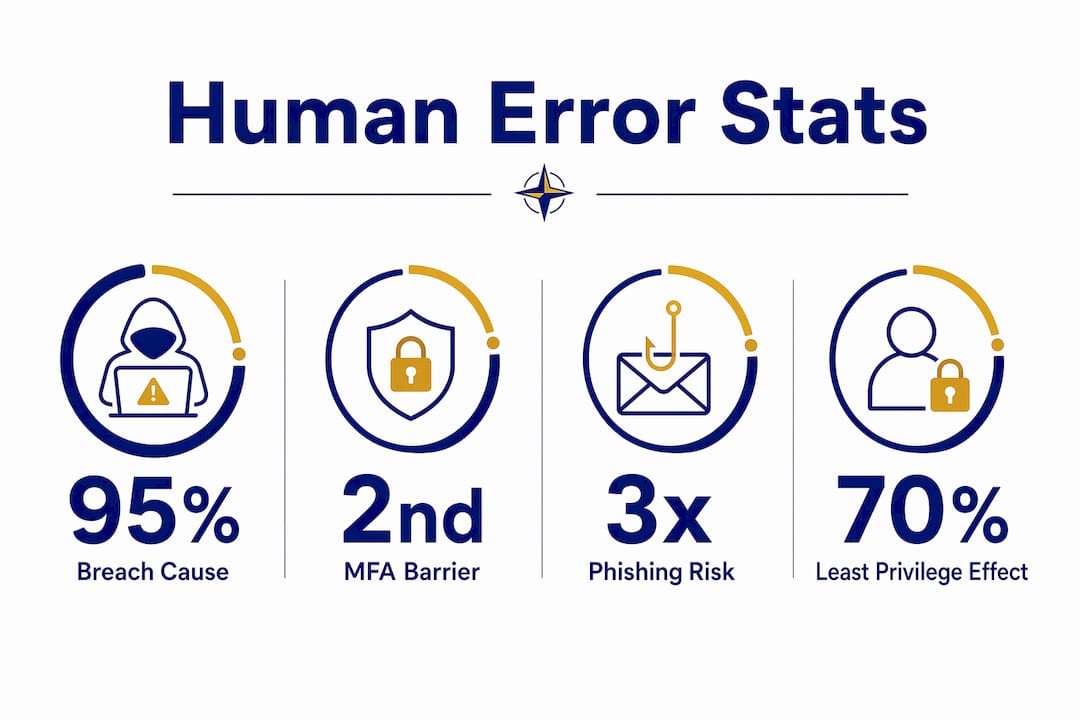
Human error is the leading cause of cybersecurity incidents, responsible for 95% of breaches across industries. That figure is not a reason for despair. It is a clear signal that the most powerful place to invest your security effort is in the people and systems that surround human behaviour. Knowing how to reduce human error in cybersecurity means combining technical controls, smarter system design, and a culture where people feel safe enough to speak up. Cybercompassconsulting has spent over 35 years working at exactly this intersection of behaviour and security.
How does a least-privilege access model reduce human error in cybersecurity?
Least-privilege access is the practice of giving each person only the permissions they need to do their job, nothing more. When someone makes a mistake, whether clicking a bad link or misconfiguring a setting, least-privilege limits how far that mistake can travel. Quarterly permission reviews combined with a zero-trust policy mean that over-provisioned accounts get caught and corrected before they become a liability.
Mandatory Multi-Factor Authentication (MFA) adds a second barrier between a credential mistake and a full breach. Even when a password is phished or reused, MFA stops the attacker from going further. Industry guidance for 2026 stresses that MFA and permission audits together reduce the “blast radius” of any single human error.
Control | Primary benefit | Key limitation |
Least-privilege access | Limits damage from compromised accounts | Requires regular review to stay current |
Mandatory MFA | Blocks credential misuse even after phishing | User friction if poorly implemented |
Quarterly access audits | Removes stale permissions before misuse | Time-intensive without automation support |
Pro Tip: Run your first access audit by exporting a full permissions report and flagging any account with admin rights that has not been used in 90 days. That list alone often reveals your highest-risk exposure.
What is Human Risk Management and how does it prioritise reducing human error?
Human Risk Management (HRM) is a framework that uses behavioural data, identity signals, and threat exposure information to identify which people in your organisation carry the most risk at any given moment. It is different from traditional security awareness training, which treats every employee as equally at risk and delivers the same content to everyone. HRM is targeted. Research shows that 10% of high-risk users drive 73% of total security risk. That concentration means blanket training is an inefficient use of your resources.
Implementing HRM involves five practical steps:
Baseline your risk profile. Collect data on phishing click rates, policy violations, and access anomalies across your organisation.
Identify high-risk users. Use behavioural signals and identity data to flag the small group generating disproportionate risk.
Design targeted interventions. Deliver specific coaching, access restrictions, or workflow changes to those users rather than the whole workforce.
Monitor and adjust. Track whether interventions reduce risk signals over time and refine your approach based on outcomes.
Integrate with your cyber wellness plan. Embed HRM findings into broader organisational health and security culture work.
The power of HRM is that it shifts security from a compliance checkbox to a living, responsive system. You stop guessing and start acting on evidence.
Pro Tip: Phishing simulations are most effective when used diagnostically. Use the data to identify cognitive load issues and improve system design, not to shame individuals who click.
How can system design and automation reduce cybersecurity mistakes?
The most underused strategy in preventing human error is designing systems that make the secure choice the easiest choice. If your MFA process takes 45 seconds and your password reset takes 10 minutes, people will find workarounds. Cognitive overload and fatigue are direct drivers of security mistakes, and most organisations design their security tools as if humans have unlimited patience and attention.
Biometrics and single sign-on (SSO) reduce the number of decisions a person must make each day. Fewer decisions mean fewer opportunities for error. Automation scales human error when it is built on flawed assumptions, so every automated control needs fault tolerance built in from the start.

Security measure | User experience benefit | Risk to manage |
Biometric authentication | Removes password fatigue entirely | Device dependency and enrolment friction |
Single sign-on (SSO) | One login reduces repeated credential entry | Single point of failure if SSO is compromised |
Automated access revocation | Removes stale accounts without manual effort | Requires accurate offboarding triggers |
Contextual MFA prompts | Only triggers when risk signals are elevated | Needs well-tuned risk scoring to avoid gaps |
The role of communication in cybersecurity matters here too. When teams understand why a security control exists, they are far more likely to use it correctly and report when it breaks down.
Pro Tip: Before deploying any new security tool, run a five-person usability test with real staff. If three or more people struggle with the same step, the design is the problem, not the people.
What cultural steps build psychological safety and minimise security errors?
Psychological safety in cybersecurity means your team members believe they can report a mistake, a near-miss, or a suspicious email without being punished or embarrassed. Without it, errors stay hidden until they become breaches. Cybersecurity cultures that avoid punitive measures and actively encourage reporting turn employees into an early warning system. That is a structural advantage no technical tool can replicate.
Building this culture requires deliberate action from both HR and security teams. The cyber safety workflow for HR is a practical starting point for organisations that want to embed security ownership into everyday people management. Here is what that looks like in practice:
Establish a no-blame reporting channel. Create a dedicated, low-friction way for staff to flag mistakes or suspicious activity without fear of consequences.
Celebrate near-miss reports. Publicly acknowledge when someone catches a threat early. This signals that reporting is valued, not penalised.
Replace punitive retraining with post-incident learning. After a security incident, run a structured review focused on what the system failed to prevent, not who failed to follow a rule.
Include security in onboarding and regular team conversations. Security ownership grows when it is part of everyday work, not a once-a-year compliance module.
Address workload and stress as security risks. Managing staff workload directly reduces the cognitive overload that leads to errors.
The 90-5-5 concept, developed by security researchers, frames this well. Investing in better tools and resource allocation reduces the impact of the 90% of breaches caused by human error far more effectively than blame ever will.
Pro Tip: Run a quarterly anonymous survey asking staff how confident they feel reporting a security mistake. A low confidence score is your clearest signal that culture work is needed before any new technical control.
Key takeaways
Reducing human error in cybersecurity requires combining least-privilege access controls, targeted Human Risk Management, user-centred system design, and a psychologically safe reporting culture.
Point | Details |
Human error drives most breaches | 95% of cybersecurity incidents involve human factors, making people the primary risk surface. |
Least-privilege and MFA limit damage | Restricting access and requiring MFA reduces how far any single mistake can travel. |
HRM targets the highest-risk users | 10% of users drive 73% of risk, so targeted interventions outperform blanket training. |
System design prevents errors at source | Biometrics, SSO, and fault-tolerant automation reduce cognitive friction and error rates. |
Psychological safety enables early detection | No-blame cultures turn staff into an early warning system, catching threats before they escalate. |
Why I think we’ve been solving this problem backwards
I have worked in cyber wellness long enough to see the same pattern repeat. An organisation suffers a breach, traces it back to a human error, and responds by booking more training. The training runs, the compliance box gets ticked, and within six months the same vulnerabilities are back. The problem was never that people needed more information. The problem was that the systems around them were designed for machines, not humans.
Eliminating human error is impossible. Every security expert who has been honest about this knows it. What we can do is build systems that expect errors and contain them. We can create cultures where a mistake is a learning signal, not a career risk. We can use behavioural data to find the small group of people who need real support, and give it to them directly.
What I find most encouraging in 2026 is the shift toward socio-technical thinking. Security teams are finally asking “why did the system allow this to happen?” instead of “who clicked the wrong thing?” That is a profound change. It moves the conversation from blame to design, from punishment to prevention.
The organisations I see making the most progress are not the ones with the biggest security budgets. They are the ones where the security team and the HR team are actually talking to each other, where staff feel safe enough to say “I think I made a mistake,” and where leadership treats a near-miss report as good news. That combination of technical rigour and human care is what sustainable security looks like.
— Jemma
Cybercompassconsulting’s approach to human risk in organisations
Cybercompassconsulting works with corporate teams and organisations to address the human side of cybersecurity through evidence-based programmes that go well beyond standard compliance training.
If your team is ready to move from reactive training to a structured approach, the cyber wellness plan service is designed specifically for organisations managing human risk at scale. Cybercompassconsulting also offers corporate cybersecurity programmes that integrate behavioural science with practical security culture work. You can book a consultation to discuss your organisation’s specific needs and get a plan that fits your people, not just your policy framework.
FAQ
What percentage of cybersecurity breaches involve human error?
Research shows 95% of cybersecurity incidents are primarily caused by human error, including misuse, social engineering, and inadvertent mistakes. This makes human behaviour the single largest risk factor in any organisation’s security posture.
What is Human Risk Management in cybersecurity?
Human Risk Management (HRM) is a framework that uses behavioural and identity data to identify and prioritise the highest-risk individuals in an organisation. Unlike blanket awareness training, HRM delivers targeted interventions to the small group of users who generate the most risk.
How does psychological safety reduce cybersecurity risk?
Psychological safety encourages staff to report mistakes and near-misses without fear of punishment, turning employees into an early detection system. Organisations with no-blame reporting cultures catch threats earlier and recover faster than those that rely on punitive responses.
Why is least-privilege access important for reducing human error?
Least-privilege access limits the damage any single mistake can cause by ensuring people only have the permissions they genuinely need. Combined with quarterly access reviews and mandatory MFA, it significantly reduces the blast radius of credential misuse or accidental misconfiguration.
Does more security training reduce human error?
Training alone does not reliably reduce human error when the underlying systems are poorly designed or cognitively demanding. The most effective approach combines targeted training with user-friendly system design, HRM frameworks, and a culture that treats errors as learning opportunities rather than failures.
Recommended
Comments