Role of communication in cybersecurity: 2026 guide
- jemmarenshaw
- Jun 24
- 7 min read
Communication is a foundational control in cybersecurity, not a soft skill or an afterthought. The role of communication in cybersecurity spans every phase of an organisation’s security posture: before threats materialise, during active incidents, and in the recovery that follows. Training delivered to over 60 cybersecurity experts by EU CyberNet in may 2026 confirms this phased approach as central to cyber resilience. Without clear, planned communication, even technically sound defences can collapse under the weight of confusion, conflicting messages, and paralysed decision-making.
How does effective communication enhance cybersecurity resilience?
Clear communication is the mechanism that keeps an organisation functional when everything else is under pressure. During an incident, it coordinates response teams, aligns stakeholders, and prevents the kind of conflicting messages that turn a technical problem into a reputational crisis. Calm, transparent communication empowers organisations and individuals, preventing the paralysis that fear-based messaging creates.

The difference between a well-managed incident and a catastrophic one often comes down to whether people knew what to do, who to contact, and what not to say publicly. Effective cybersecurity communication strategies answer those questions before anyone needs to ask them under pressure. Think of it like a fire drill. The drill itself does not put out fires. It means that when smoke appears, no one freezes.
Structured crisis communication addresses a specific set of questions that must be answered during any incident:
Who is leading the response?
What do we know for certain right now?
What are we still investigating?
Who needs to be told, and when?
What must not be communicated yet?
Which channels are safe to use?
Effective crisis communication must answer these 10 critical questions to prevent inconsistent messaging and reduce harm. Each unanswered question is a gap where rumour, speculation, or panic can take hold.
“Communication is part of the incident response, not an afterthought. It must be integrated as a control to manage uncertainty and enable decisions.” — cybersecurity101.net
The importance of communication in cybersecurity also shows up in how different audiences receive information. Executives prefer decision-focused updates rather than exhaustive technical logs during incidents. That means the same event requires different messages for the board, the IT team, and the frontline staff. Getting that calibration right is a communication skill, not a technical one.
What are the barriers to clear cybersecurity communication?
Technical jargon is the most common barrier between security teams and the people they are trying to protect. When a cybersecurity professional explains a threat using acronyms and architecture diagrams, the non-technical audience hears noise. They disengage, and the risk goes unmanaged.
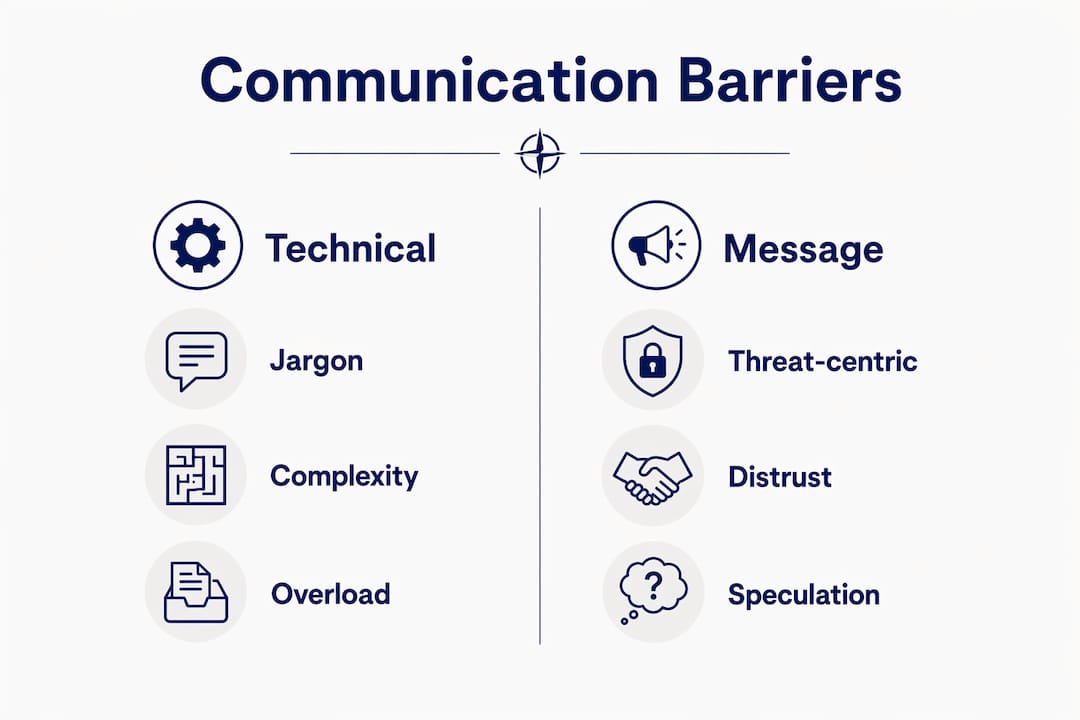
Threat-centric messaging creates a second, less obvious barrier. Excessively threat-centric messages generate distrust and anxiety. When every communication leads with worst-case scenarios and catastrophic language, audiences stop listening. They feel helpless rather than informed. The communication barriers in cybersecurity are not just technical. They are psychological.
Siloed teams create a third barrier. When the security team, the legal team, the communications team, and senior leadership each operate with different information and different priorities, messages contradict each other. That contradiction is often more damaging than the incident itself.
Practical ways to reduce these barriers include:
Replace jargon with plain language. Say “your account was accessed without permission” instead of “unauthorised credential compromise.”
Use relatable analogies. Experts recommend using metaphors such as ransomware as a criminal changing the locks on your house. That image lands immediately for a non-technical audience.
Establish a shared goal, sometimes called a “North Star,” that all teams can rally around. Defining simple, plain-language shared goals accessible to all stakeholders reduces friction from competing team objectives.
Create psychologically safe environments where staff can report concerns without fear of blame.
Pro Tip: Before your next security briefing, read your draft aloud to someone outside the IT team. If they cannot explain it back to you in one sentence, rewrite it.
How should communication be structured during a cyber incident?
Communication during an incident is a control mechanism, not a courtesy. It enables timely decisions, prevents operational paralysis, and manages the flow of information to the right people at the right time. Organisations rarely have dedicated communication plans within their incident response frameworks. That gap means technical and communication crises unfold simultaneously, compounding the damage.
The single largest communication failure during incidents is speculation. Practitioners recommend stating known facts, clearly labelling unknowns, and avoiding the urge to fill silence with guesses. Silence feels uncomfortable. Speculation feels worse in hindsight.
A second structural failure is using compromised channels. Credential-based attacks often compromise primary email and collaboration tools. If your incident response communication runs through the same systems the attacker has accessed, your response is visible to them. Pre-established, out-of-band channels, sometimes called “virtual bunkers,” must be ready before an incident occurs.
Channel type | Typical use | Risk during incident | Secure alternative |
Corporate email | General updates | High if credentials compromised | Encrypted out-of-band messaging |
Slack or Teams | Team coordination | High if tenant compromised | Pre-configured secure group chat |
Phone calls | Urgent decisions | Low to medium | Dedicated incident bridge line |
Public social media | External updates | Medium (timing sensitive) | Pre-approved holding statements |
Pro Tip: Set up your out-of-band communication channel now, before you need it. Test it quarterly. The worst time to find a broken tool is during an active incident.
Establishing a private communication log during incidents is equally important. Capturing messages and responses in a private log enables pattern recognition and supports future communication refinements. It also protects the organisation legally and operationally if the incident is reviewed later.
What are best practices for communicating cybersecurity risks to non-technical audiences?
Security professionals must communicate cybersecurity principles clearly across all team levels to enhance understanding, engagement, and risk reduction. This applies from Tier 1 analysts through to CISOs, and from IT departments through to classroom teachers and small business owners. Communication skills for cybersecurity professionals are not optional extras. They are core competencies.
The most effective approach starts with the audience, not the threat. Ask what the audience already knows, what they care about, and what behaviour you want them to change. Then build the message backwards from that behaviour.
Cybersecurity awareness communication works best when it is:
Specific. “Do not click links in unexpected emails from your bank” outperforms “be vigilant about phishing.”
Relatable. Analogies grounded in everyday experience cut through abstraction. The ransomware-as-changed-locks metaphor works because everyone has experienced being locked out.
Repeated. A single awareness session does not change behaviour. Regular, brief touchpoints across multiple formats build lasting habits.
Positive in framing. Tell people what to do, not just what to fear. Fear without direction produces anxiety, not action.
For educators working in schools, the student cyber awareness workflow developed for 2026 offers a structured approach to building these habits across a school community. Translating cybersecurity principles into age-appropriate, behaviour-focused language is a skill that benefits the entire school ecosystem, not just the IT coordinator.
The role of teamwork in cybersecurity also matters here. Awareness campaigns fail when they are designed by security teams in isolation. Involving teachers, HR professionals, and frontline staff in message design produces communication that resonates. People support what they help create.
Key takeaways
Effective cybersecurity communication requires planned, people-centred messaging before, during, and after incidents, with secure channels, plain language, and shared goals at its core.
Point | Details |
Communication is a control | Treat communication as part of incident response, not a separate function. |
Pre-plan secure channels | Set up out-of-band “virtual bunkers” before an incident compromises your primary tools. |
Avoid speculation | State known facts, label unknowns clearly, and route sensitive information to designated owners. |
Plain language builds trust | Replace jargon with relatable analogies to engage non-technical audiences effectively. |
Shared goals reduce friction | Define a simple “North Star” that aligns security, legal, communications, and leadership teams. |
What I have learned about communication and cybersecurity
I have spent a long time watching organisations invest heavily in technical defences and almost nothing in communication planning. The pattern is consistent. A well-resourced security team detects an incident. Then the wheels fall off because nobody agreed in advance on who speaks, to whom, and through which channel.
What strikes me most is how human this problem is. The technical side of cybersecurity attracts people who are genuinely brilliant at systems thinking. But systems thinking and people communication are different muscles. You can have the best incident response playbook in the industry and still watch it unravel because a senior leader sent an unvetted email to the whole company at 2am.
The organisations I have seen handle incidents well share one trait. They practised communication before they needed it. They ran tabletop exercises that included the communications team, legal, and HR, not just IT. They knew their “North Star.” They had tested their out-of-band channels. When the incident arrived, the communication felt almost calm, because the uncertainty had already been reduced by preparation.
The uncomfortable truth is that most incident response plans treat communication as a checkbox. A paragraph at the end about notifying stakeholders. That is not a communication plan. A real communication plan names owners, defines channels, pre-approves holding statements, and gets tested. If yours does not do those things, the gap is worth closing now, not after the next breach.
— Jemma
How Cybercompassconsulting supports your communication and resilience
Cybercompassconsulting works with schools, SMEs, and corporate teams to build communication into their cybersecurity frameworks from the ground up, not as an afterthought. The approach draws on over 35 years of experience integrating behavioural science with practical security planning.
Whether you need a cyber wellness plan that includes communication protocols, or tailored support for your school community, Cybercompassconsulting offers programmes designed around real human behaviour, not compliance checklists. For organisations ready to close the communication gap in their security posture, a virtual consultation is the practical first step.
FAQ
What is the role of communication in cybersecurity?
Communication is a core operational control in cybersecurity. It coordinates response teams, manages information flow during incidents, and translates technical risks into behaviour-changing guidance for non-technical audiences.
Why do most organisations fail at incident communication?
Organisations rarely have dedicated communication plans within their incident response frameworks. This means technical and communication crises unfold at the same time, compounding the damage.
What are out-of-band communication channels?
Out-of-band channels are secure communication tools kept separate from an organisation’s primary systems. They are used during incidents when email or collaboration platforms may be compromised by the attacker.
How do you communicate cybersecurity risks to non-technical staff?
Use plain language, relatable analogies, and behaviour-focused messages. Bridging technical and non-technical audiences with plain language builds the trust that enables effective cybersecurity action.
What communication skills do cybersecurity professionals need?
Cybersecurity professionals need the ability to tailor messages to different audiences, from boards to frontline staff, avoid jargon, and deliver calm, factual updates under pressure. These skills are as critical as technical expertise.
Recommended
Comments