The role of human factors in security: a 2026 guide
Why human behaviour sits at the heart of cybersecurity
People are not the weakest link in cybersecurity. They are the most complex variable, and that distinction changes everything about how we respond. The role of human factors in security goes far beyond the tired narrative of careless employees clicking dodgy links. It encompasses how we think under pressure, how organisations are designed, how culture shapes risk tolerance, and whether people feel safe enough to admit mistakes before they become catastrophes.

Human error contributes to the vast majority of data breaches—studies consistently attribute 95% of all breaches to some element of human behaviour or decision. That figure is not an indictment of individuals. It is a signal that our systems, processes, and cultures are not built around how people actually behave.
Human factors in cybersecurity draws from ergonomics, cognitive psychology, behavioural science and organisational design. The field asks a deceptively simple question: how do human beings interact with security systems, and what happens when those interactions go wrong? The answers span everything from a fatigued analyst missing a threat alert to an executive bypassing multi-factor authentication because it slows them down.
The key elements shaping human factors in security include:
Cognitive load and attention limits: people make more errors when systems are confusing, alerts are excessive, or tasks are repetitive
Insider threats: both unintentional (accidental data exposure) and intentional (malicious data theft), with negligent insiders accounting for the majority of incidents
Phishing susceptibility: social engineering exploits trust, urgency, and cognitive shortcuts rather than technical vulnerabilities
Credential misuse: weak password habits and credential sharing remain among the most exploited entry points
Organisational culture: whether employees feel psychologically safe enough to report errors shapes how quickly threats are contained
Technostress: chronic digital overload degrades decision-making quality and increases the likelihood of security slips
Humans are also the most adaptable defence asset an organisation has. A well-trained, psychologically supported workforce that understands threats in context will outperform any technical control that relies on people to operate it correctly.

What types of human behaviour actually create security vulnerabilities?
The categories of human-related risk are broader than most security frameworks acknowledge. Phishing is the obvious one, but the subtler risks often do more damage.
Behavioural factors include careless clicks, reusing passwords across personal and work accounts, ignoring software update prompts, and sharing credentials with colleagues for convenience. These are not signs of stupidity. They are predictable responses to poorly designed systems that create friction without explaining why.
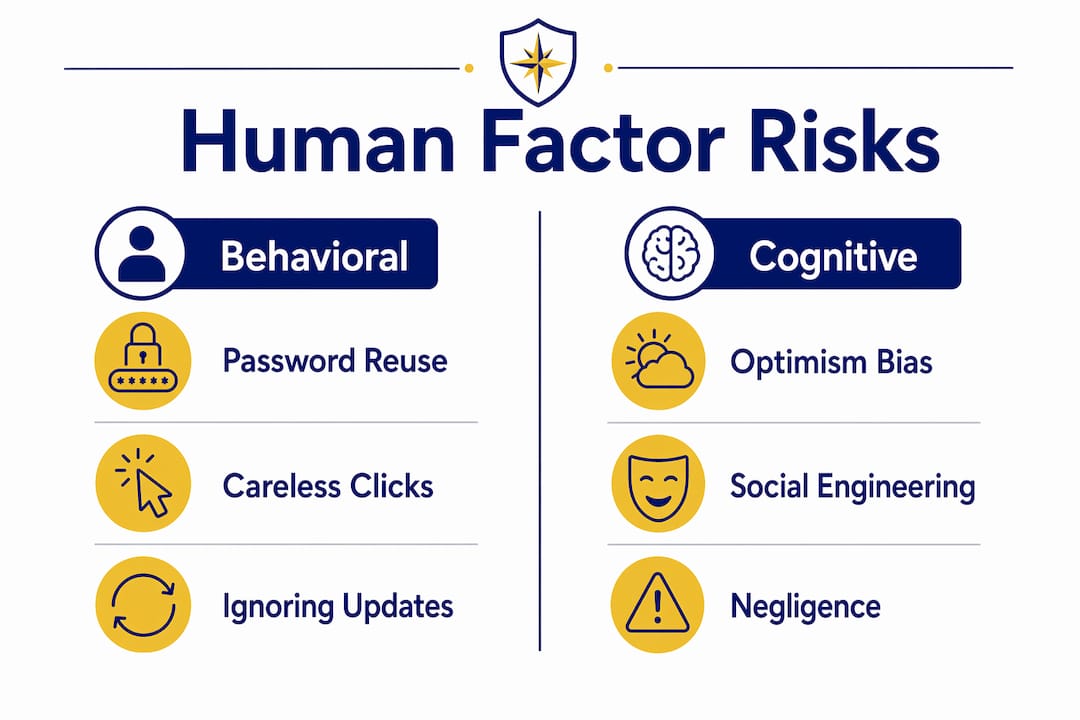
Cognitive biases play a significant role too. Optimism bias leads people to underestimate the likelihood that they will be targeted. Authority bias makes employees comply with urgent requests that appear to come from senior leaders, which is the mechanism behind business email compromise fraud. Confirmation bias causes security analysts to dismiss anomalies that do not fit their existing mental model of a threat.
Stress-induced errors are particularly underappreciated. Research from ISACA confirms that when users feel ambiguity or confusion in a system’s design, stress increases, and with it the likelihood of irrational decisions. A help desk worker fielding 80 calls a day is not in the cognitive state to carefully evaluate every suspicious email.
Insider threats deserve their own taxonomy:
Unintentional insiders: employees who accidentally expose data, misconfigure systems, or fall for phishing without any malicious intent
Negligent insiders: staff who know the policy but bypass it for convenience, such as emailing sensitive files to a personal account
Malicious insiders: individuals who deliberately exfiltrate data, often motivated by financial gain, grievance, or coercion
Pro Tip: When mapping insider threat risk, do not focus solely on the malicious category. Negligent behaviour, which is far more common, tends to create the access pathways that malicious actors later exploit.
A real-world illustration: the 2022 Medibank data breach in Australia exposed the personal health records of nearly 9.7 million customers. The initial access point was compromised credentials, obtained because an employee’s login details were available on the dark web. No sophisticated exploit. Just a human behaviour pattern, password reuse, that the organisation’s systems did not adequately guard against.
The statistics that make the case for taking human error seriously
The numbers on human error in security are not ambiguous. They point consistently in one direction.
Ninety-five percent of cybersecurity breaches trace back to human error. Sophisticated attackers do not primarily target technology. They target the least careful moment in a person’s day.
95% of breaches involve a human element. Yet most security budgets still allocate the majority of spending to technical controls rather than the people operating them.
The Verizon 2025 Data Breach Investigations Report found that 60% of breaches involved human error, with credential abuse accounting for 22% of incidents as the single most common initial attack vector. That means attackers are not breaking in. They are logging in, using credentials that humans created, shared, or failed to protect.
Human factor category | Contribution to breaches |
Human error (overall, per UpGuard and InformationWeek) | 95% of all breaches |
Breaches involving human error (per Verizon 2025 DBIR) | 60% |
Credential abuse as initial vector | 22% of incidents |
Negligent insider behaviour | 42% of data loss events |
Staff responsible for 80% of incidents | 8% of the workforce |
The concentration finding is particularly striking. Just 8% of staff account for 80% of security incidents. This does not mean those individuals are uniquely reckless. It usually means they occupy roles with elevated access, higher workloads, or less security support than their risk exposure warrants.
Seventy-four percent of CISOs identify human error as their organisation’s top cybersecurity risk. That is not a fringe view. It is the consensus among the people paid to understand the threat landscape. And yet the standard response, an annual compliance training module, has been shown repeatedly to produce minimal lasting behaviour change.
Sector-specific impacts compound the picture. Financial services organisations face elevated credential abuse risk because of the value of the data they hold. Energy sector breaches increasingly involve operational technology environments where human error can have physical consequences. Retail organisations contend with high staff turnover, which means security culture never fully consolidates before the next wave of new employees arrives.
How leaders can actually reduce human-related cybersecurity risks
The most common mistake organisations make is treating human error as a training problem. It is a design problem, a culture problem, and a leadership problem, with training as one tool among many.
Systemic failures underlie most security incidents attributed to individual error. Blaming the employee who clicked a phishing link does nothing to fix the email filtering system that let it through, the workload that left them too rushed to scrutinise it, or the culture that made them afraid to report the click once it happened.
Effective organisational strategies include:
Shift from blame to systems thinking: when an incident occurs, ask what in the environment made the error likely, not just who made it
Build psychological safety: a culture where errors are reported promptly enables faster containment; fear of punishment drives incidents underground
Design for human cognitive limits: human factors engineering principles from aviation and healthcare can be applied to authentication flows, alert systems, and access controls to reduce cognitive load
Run phishing simulations and red team exercises: these drills reveal procedural gaps and give employees practice recognising threats in a low-stakes environment
Make continuous training the norm: short, frequent, contextually relevant learning beats the annual compliance module every time
Redesign workflows that create friction: if the secure path is harder than the insecure one, people will take the insecure one
Leadership visibility matters enormously here. When executives model good security behaviour, including using MFA, reporting suspicious emails, and speaking openly about near-misses, it signals that security is a shared responsibility rather than an IT department problem.
Pro Tip: Incorporate a “security usability review” into every new system deployment. Ask frontline staff to complete common tasks and observe where they hesitate, skip steps, or create workarounds. Those friction points are your highest-risk moments.
For Australian organisations, the Privacy Act 1988 and the Notifiable Data Breaches scheme create a compliance floor, but the organisations that genuinely reduce human risk go well beyond compliance. They treat security culture as an ongoing investment, not a checkbox.
How AI and behavioural tools are changing the human factors equation
Technology is beginning to address human factors in ways that go beyond locking things down. The more interesting developments work with human behaviour rather than against it.
AI-driven security tools now predict human-related risks by analysing patterns in user behaviour, flagging anomalies before they become incidents. Insider threat detection platforms use machine learning to identify when an employee’s access patterns deviate from their baseline, which can indicate either a compromised account or a disgruntled insider preparing to exfiltrate data.
Behavioural biometrics take this further by continuously verifying user identity through typing rhythm, mouse movement patterns, and device interaction habits. Unlike a password, these signals are nearly impossible to replicate, and they operate invisibly in the background without adding friction to the user experience.
Real-time nudges are among the most promising developments. Rather than waiting for annual training, these systems intervene at the moment of risk. When an employee is about to send an email containing what appears to be sensitive data to an external address, a prompt appears asking them to confirm. The intervention is brief, contextual, and far more effective than a classroom reminder delivered months earlier.
The shadow IT problem, however, is growing faster than these tools can address it. Eighty-one percent of employees now use unmanaged generative AI tools at work, creating data exposure risks that most organisations have not yet accounted for in their security policies. An employee pasting client data into an AI chatbot to draft a report is not acting maliciously. They are solving a work problem with the tools available to them. The risk is real regardless of intent.
Technology | Primary benefit | Key challenge |
AI-driven anomaly detection | Early identification of insider threats | High false positive rates require tuning |
Behavioural biometrics | Continuous, frictionless identity verification | Privacy considerations and data governance |
Real-time nudges | Contextual intervention at the moment of risk | Requires integration with existing workflows |
Generative AI governance tools | Monitoring and policy enforcement for AI use | Rapidly evolving tool landscape |
Phishing simulation platforms | Measurable behaviour change over time | Simulation fatigue if overused |
The organisations getting the most value from these technologies are those that pair them with cultural change. A nudge system deployed in a blame culture will be ignored or resented. The same system in a psychologically safe environment becomes a genuine learning moment.
For those building foundational security knowledge, resources like Microsoft Security Fundamentals provide a useful grounding in how technical and human controls interact across an organisation’s security architecture.
How Cybercompassconsulting approaches cyber wellness to reduce human error
Cybercompassconsulting has spent over 35 years working at the intersection of behavioural science and cybersecurity, and the clearest lesson from that experience is this: you cannot train your way out of a culture problem.
Reducing human error in security requires more than awareness campaigns. It requires addressing the psychological conditions, including technostress, cognitive overload, and fear of blame, that make errors more likely in the first place. When people feel supported rather than surveilled, they make better decisions and report problems sooner.
The approach Cybercompassconsulting brings to Australian organisations, schools, and families centres on cyber wellness as a discipline distinct from compliance. Compliance asks: are people following the rules? Cyber wellness asks: are people in the psychological and organisational conditions that make safe behaviour sustainable?
Practical elements of this approach include:
Technostress assessment and management: identifying where digital overload is degrading decision quality and designing interventions that reduce cognitive burden
Personalised coaching programmes: working with individuals and teams to build genuine security habits, not just procedural knowledge
School and family programmes: extending cyber wellness beyond the workplace to the environments where digital habits are formed earliest
Cultural diagnostics: assessing whether an organisation’s security culture encourages transparency or suppresses it
The evidence base for this approach is clear. Long-term behavioural transformation builds security culture in ways that one-off training cannot. Psychological safety enables employees to report mistakes promptly, which is the single most important factor in containing a breach before it escalates.
Pro Tip: Start any cyber wellness programme with a culture audit, not a training needs analysis. Understanding whether people feel safe to report errors tells you more about your actual risk exposure than any technical vulnerability scan.
Cybercompassconsulting’s cyber wellness planning service works with organisations to build this foundation systematically, addressing the human and organisational conditions that determine whether technical controls actually work in practice.
What psychology tells us about why people make security mistakes
Understanding why humans behave the way they do under security conditions requires more than common sense. Several well-established psychological frameworks explain the patterns we see in breach data.
Dual-process theory, developed by Daniel Kahneman and Amos Tversky, distinguishes between fast, intuitive thinking (System 1) and slow, deliberate reasoning (System 2). Most security decisions happen under System 1 conditions: time pressure, distraction, and cognitive load. Phishing attacks are designed to exploit exactly this, creating urgency that bypasses careful analysis.
Cognitive load theory explains why complex security interfaces produce errors. When a system demands more mental effort than a person has available, they simplify. They reuse passwords because creating unique ones for every account exceeds their cognitive budget. They approve MFA prompts without reading them because the alternative is interrupting their workflow.
Protection motivation theory offers a model for why security awareness training so often fails to change behaviour. People assess both the severity of a threat and their own capacity to respond to it. If they believe a threat is unlikely to affect them, or that the recommended action is too difficult, they do not act. Training that focuses on threat severity without building genuine self-efficacy tends to produce anxiety rather than behaviour change.
Social proof and authority are the psychological levers most exploited in social engineering. People look to others to determine appropriate behaviour, and they comply with apparent authority figures even when the request is unusual. Business email compromise fraud succeeds because it mimics both: an urgent request from someone who appears to be a senior leader.
The science of security as a discipline argues for applying these principles systematically, using human information-processing research to design security systems and training that work with cognitive architecture rather than against it. For those wanting to deepen their technical understanding of how attackers exploit these patterns, ethical hacking certification programmes provide a practitioner-level view of the human vulnerabilities that penetration testers routinely exploit.
What Australian organisations face that others do not
Australia’s cybersecurity context has features that make human factors considerations particularly acute. The Australian Cyber Security Centre’s annual threat reports consistently identify credential compromise and phishing as the dominant attack vectors, which maps directly onto the human factor risks described throughout this article.
The Australian workforce has specific characteristics that shape security culture. Geographic dispersion across time zones means remote and hybrid work is not a pandemic-era anomaly but a structural feature of how many organisations operate. Remote workers face elevated phishing risk, reduced access to informal security guidance from colleagues, and greater reliance on personal devices and home networks.
Australia’s multicultural workforce is an asset in many respects, but it creates complexity for security awareness programmes. Training materials designed for a homogeneous cultural context may not resonate across the full range of communication styles, trust frameworks, and authority relationships present in a diverse team. Effective programmes need to account for this.
The regulatory environment is also evolving rapidly. The Privacy Act reforms progressing through Parliament, combined with the Cyber Security Act 2024, are raising the bar for what constitutes adequate security governance. Human factors considerations are increasingly embedded in regulatory expectations, not just best practice guidance.
Small and medium enterprises represent a particular vulnerability. They often lack dedicated security staff, which means the human factors burden falls on generalist employees with no security background. The Australian Signals Directorate’s Essential Eight framework provides a baseline, but implementing it effectively requires the kind of cultural and behavioural change that technical guidance alone does not address.
How human factors should shape security policy and compliance
Security policy that ignores human behaviour tends to produce one of two outcomes: non-compliance or the illusion of compliance. People find workarounds, and the workarounds become the actual security posture of the organisation.
Effective policy design incorporates usability as a core requirement, not an afterthought. Jakob Nielsen’s usability principles, including learnability, efficiency, memorability, and error recovery, apply as directly to security policies and authentication systems as they do to any other user interface. A password policy that forces frequent changes and complex requirements does not improve security. Research shows it leads to weaker passwords that are minimally compliant and easily guessed.
Integrating human factors into policy development means:
Involving frontline staff in policy design: the people who will live with a policy understand its friction points better than those who write it
Testing policies before deployment: observe how real users interact with new requirements and identify where they will fail before the policy goes live
Building in error recovery: assume people will make mistakes and design policies that make recovery straightforward rather than punitive
Aligning policy with workflow: security controls that interrupt productive work will be bypassed; controls that fit naturally into existing processes will be followed
Compliance frameworks like ISO 27001 and the NIST Cybersecurity Framework both acknowledge human factors, but their guidance tends to be high-level. The practical work of embedding human considerations into specific policies requires the kind of behavioural expertise that most compliance teams do not have in-house.
The human-centric cybersecurity approach offers a framework for this, treating policy not as a set of rules to be enforced but as a design challenge to be solved with the people it affects.
Key takeaways
Human factors drive the majority of cybersecurity breaches, and addressing them requires systemic design changes, cultural investment, and sustained behavioural support rather than compliance training alone.
Point | Details |
Human error dominates breach data | 95% of breaches are linked to human error according to multiple sources, while Verizon 2025 DBIR attributes 60% of breaches to human error and notes credential abuse as the most common initial attack vector. |
Culture shapes risk more than training | Psychological safety and blame-free reporting cultures contain incidents faster than any single training programme. |
System design reduces errors at source | Applying human factors engineering to authentication, alerts, and workflows cuts cognitive load and prevents mistakes before they occur. |
Emerging AI tools need cultural pairing | Behavioural biometrics and real-time nudges work best when deployed alongside genuine cultural change, not as a substitute for it. |
Australian context requires tailored responses | Geographic dispersion, workforce diversity, and evolving regulation make locally adapted, behaviourally grounded programmes more effective than generic frameworks. |
Ready to address the human side of your security posture?
The technical controls are only as strong as the people operating them. If your organisation is serious about reducing human-related security risk, the starting point is understanding the behavioural and cultural conditions that make your people either your greatest vulnerability or your most resilient defence.
Cybercompassconsulting works with Australian businesses, schools, and families to build cyber wellness programmes that address the root causes of human error, from technostress and cognitive overload to security culture and policy design. With over 35 years of experience integrating behavioural science with practical security strategy, the team brings a depth of expertise that goes well beyond standard compliance consulting.
Whether you are an SME looking to build your first security culture programme or a corporate team seeking to embed human factors thinking into your governance framework, Cybercompassconsulting’s corporate cybersecurity services offer a structured, evidence-based path forward. The work of reducing human error starts with understanding why it happens, and that understanding is where lasting change begins.
Recommended
Comments