The role of policy in cyber hygiene: 2026 guide
- jemmarenshaw
- Jun 16
- 8 min read
Cyber hygiene is defined as the set of consistent, practised behaviours and technical controls that protect an organisation’s digital assets from compromise. The role of policy in cyber hygiene is to provide the foundational framework that directs those behaviours, making security repeatable, measurable, and enforceable rather than left to individual judgement. Without policy, even well-intentioned staff default to convenience over caution. Properly implemented policies can prevent up to 98% of cyberattacks, according to 2026 guidance from the Conference of State Bank Supervisors (CSBS) citing former CISA leadership. That single figure reframes the entire conversation: policy is not a compliance formality. It is your most powerful risk reduction tool.
How cyber hygiene policies structure and enforce security practices
Policy gives structure to what would otherwise be informal, inconsistent security habits. The most effective cyber hygiene policies specify not just what staff must do, but when and how. Critical patches applied within 48 hours and all other updates completed within 14 days are now considered standard practice. That specificity matters because vague guidance like “keep systems updated” produces wildly different interpretations across teams.
Technical mandates are the backbone of any serious policy. Mandatory multi-factor authentication (MFA), endpoint detection and response (EDR) tools, password managers, and conditional access controls are no longer optional extras. They are the floor. Organisations that leave these to individual discretion are, in effect, outsourcing their security posture to their least security-conscious employee.

Training integration is equally non-negotiable. Cyber hygiene policies embedded in onboarding for 100% of new hires, with ongoing training tracked and documented, build stronger compliance and defensible audit trails. The tracking piece is often overlooked. Knowing who completed training and when is not bureaucracy. It is evidence of due diligence when something goes wrong.
Policy element | Best practice | Common gap |
Patch management | Critical fixes within 48 hours; all others within 14 days | No defined timeline; patching done “when possible” |
MFA enforcement | Mandatory across all systems and user accounts | Optional or limited to high-privilege accounts only |
Training documentation | 100% onboarding coverage with completion tracking | Annual tick-box exercise with no follow-up |
Incident reporting | Clear, blame-free reporting channels with defined escalation | Punitive culture discourages staff from reporting near-misses |
Password management | Organisation-wide password manager with enforced complexity | Informal guidance with no enforcement mechanism |
Pro Tip: Review your policy documents against this table annually. If your organisation has gaps in more than two rows, your written policy is outpacing your lived practice, and that gap is where breaches happen.
Does leadership behaviour shape policy effectiveness?
Written policy without leadership commitment is a document, not a culture. Lynn Soeth at High Point Networks makes this point directly: leadership that communicates security responsibility clearly and creates psychologically safe reporting spaces builds the kind of security culture that actually holds under pressure. When staff fear blame for clicking a phishing link, they hide it. When they feel safe reporting it, the organisation learns and adapts.
The CSBS 2026 guidance takes this further, advising that boards engaging with specific cybersecurity questions improve communication and policy oversight across the organisation. This is not about boards becoming technical experts. It is about leaders asking the right questions: “What is our current patch compliance rate?” or “How many incidents went unreported last quarter?” Those questions signal that security is a leadership priority, not just an IT concern.
Culture-building requires more than a memo. Recognition programmes, internal security champions, and regular engagement campaigns all contribute to shifting attitudes over time. Consider what Wiz describes as the real value of strong policy: a shared organisational language that aligns security, engineering, and legal teams around common expectations. When everyone speaks the same security language, policy adherence stops feeling like compliance and starts feeling like professional identity.
Appoint security champions in each team or department to model and reinforce policy expectations
Celebrate near-miss reporting publicly to normalise transparency over blame
Include cybersecurity as a standing agenda item in leadership meetings, not just after incidents
Use scenario-based discussions at the board level to practise decision-making before a real crisis hits
“Empowered employees with clear roles improve incident response and ongoing security.” — Lynn Soeth, High Point Networks
Pro Tip: If your leadership team cannot answer basic questions about your organisation’s current security posture without asking IT first, that is a governance gap. Build a monthly one-page security dashboard specifically for non-technical leaders.
How should policy differ for remote and hybrid workers?
One-size-fits-all policy is one of the most common and costly mistakes organisations make. Policy adherence varies significantly between remote and hybrid workers, according to 2026 research published in the Security Journal. Remote workers are more influenced by established security habits, while hybrid workers respond more strongly to explicit policy enforcement. That distinction has real implications for how you design and communicate your security requirements.
The behavioural science behind this is worth understanding. Remote workers, operating without the social cues of an office environment, rely more heavily on internalised habits. If those habits were never properly formed through structured onboarding and reinforcement, remote work amplifies the risk. Hybrid workers, who move between environments, need clearer policy signals because their context shifts constantly.
Differentiated policy communication is not about creating two separate rulebooks. It is about tailoring the emphasis, the reminders, and the enforcement mechanisms to match how people actually work.
Remote workers: Prioritise habit formation through structured onboarding, regular micro-training, and automated technical controls like VPN enforcement and device compliance checks.
Hybrid workers: Emphasise explicit policy reminders when workers transition between environments, such as automated prompts when connecting from non-office networks.
All staff: Maintain a single, clear policy document with role-specific annexures that address the unique risks of each work modality.
Managers: Train team leaders to have brief, regular security conversations with their direct reports rather than relying solely on formal training sessions.
New starters in remote roles: Extend the onboarding security training period and include a dedicated check-in at 30 and 90 days to assess policy understanding and habit formation.
The research is clear that hybrid and remote workers respond differently to policy versus habit-based approaches. Organisations that acknowledge this distinction in their policy design will see meaningfully better adherence than those that do not.
Practical strategies for embedding cyber hygiene policy into daily routines
Policy that lives only in a PDF on the intranet is not policy in any meaningful sense. Embedding cyber hygiene into organisational routines requires deliberate integration at every touchpoint where security decisions are made. Start with onboarding. Every new hire, regardless of role, should complete a structured security orientation that connects policy requirements to their specific job context.
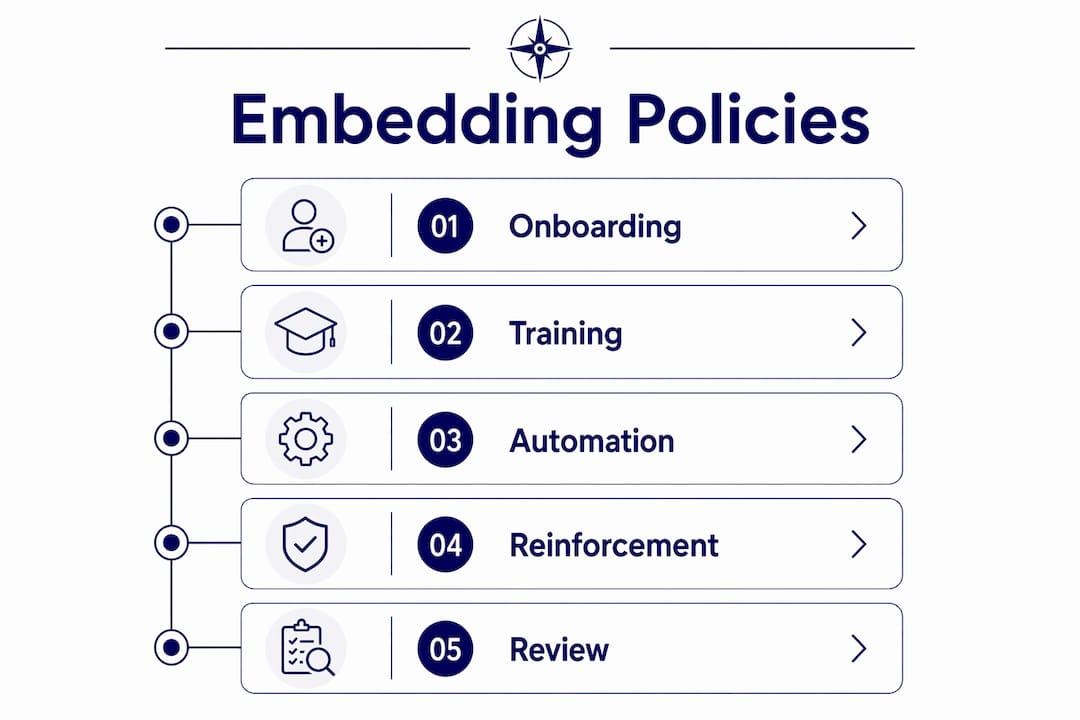
Ongoing reinforcement matters more than most leaders realise. Regular scenario-based training and tabletop exercises build readiness and shift culture over time far more effectively than annual compliance sessions. A tabletop exercise that asks your leadership team to respond to a simulated ransomware attack will surface policy gaps that no audit ever would. It also builds the muscle memory that makes real incident response faster and less chaotic.
Automation is the multiplier that makes policy scalable. Automated enforcement through layered technical controls including MFA, EDR, and conditional access removes the burden of compliance from individual judgement. When MFA is mandatory and technically enforced, it does not matter whether an employee remembers to enable it. The system handles it.
Enforcement method | Traditional approach | Automated approach |
MFA compliance | Remind staff via email; rely on self-reporting | Technically enforced; access blocked without MFA |
Patch management | IT team manually tracks and deploys updates | Automated patch deployment with compliance dashboards |
Policy acknowledgement | Annual paper or PDF sign-off | Digital tracking with automated reminders and escalation |
Incident reporting | Staff email IT or manager | Dedicated reporting tool with anonymous option and auto-triage |
Pro Tip: Map every policy requirement to a technical control where possible. If a policy says “use a strong password,” the technical control is a password manager with enforced complexity. Policy and technology should reinforce each other, not operate in parallel.
Key takeaways
Effective cyber hygiene depends on policy that is specific, enforced technically, embedded in culture, and adapted to how people actually work.
Point | Details |
Policy prevents most attacks | Properly implemented cyber hygiene policies can prevent up to 98% of cyberattacks, making them the highest-leverage security investment. |
Technical controls enforce policy | MFA, EDR, and conditional access remove reliance on individual compliance and scale security across the organisation. |
Leadership shapes culture | Leaders who ask specific security questions and model safe reporting create cultures where policy is lived, not just documented. |
Remote and hybrid workers need tailored approaches | Policy communication and enforcement must match work modality, as remote and hybrid workers respond to different motivators. |
Automation closes the enforcement gap | Automated policy enforcement replaces manual reminders and reduces the risk of human error undermining written requirements. |
What I have learned about policy and cyber hygiene after 35 years
After working with schools, SMEs, and corporate teams for over three decades, I have come to one uncomfortable conclusion: most organisations treat policy as the finish line when it is actually the starting line. The document gets written, approved, and filed. Then everyone assumes the work is done.
The organisations that genuinely reduce their cyber risk do something different. They treat policy as a living conversation, not a static artefact. They revisit it after near-misses. They ask staff what parts feel unclear or impractical. They adjust. That willingness to iterate is what separates a security culture from a security theatre.
What I find most encouraging is how much behavioural science has to offer here. When you understand why people bypass security controls (cognitive overload, habit, social norms), you can design policy and technical environments that work with human behaviour rather than against it. That is the approach Cybercompassconsulting takes, and it consistently produces better outcomes than compliance-first frameworks.
The hardest conversation I have with leaders is this: if your staff are not following your policies, the policy is probably the problem, not the people. Blame is easy. Redesign is harder and far more effective.
— Jemma
How Cybercompassconsulting supports your cyber hygiene policy journey
Cybercompassconsulting works with schools, SMEs, and corporate teams to build cyber hygiene programmes that go beyond compliance and into genuine culture change. The approach integrates behavioural science with practical policy design, so your security requirements are not just written down but actually followed.
If you are an organisational leader, educator, or policy maker looking to strengthen your security posture, the SME business programme offers tailored support for policy development, staff training, and security culture building. For schools and education leaders, the schools programme addresses the unique challenges of digital safety in educational environments. You can also build a cyber wellness plan designed specifically for your organisation’s context, or book a consultation to start the conversation today.
FAQ
What is the role of policy in cyber hygiene?
Policy defines the specific behaviours, technical requirements, and accountability structures that make cyber hygiene consistent and enforceable across an organisation. Without policy, security depends on individual awareness, which is unreliable at scale.
How does policy impact cybersecurity outcomes?
Properly implemented cyber hygiene policies can prevent up to 98% of cyberattacks, according to CSBS 2026 guidance citing former CISA leadership. Policy translates security intent into measurable, enforceable practice.
What are the best practices for cyber hygiene policies?
Best practices include mandatory MFA, patching critical vulnerabilities within 48 hours, embedding training in onboarding with tracked completion, and automating technical controls to enforce compliance without relying on individual memory.
How should policies differ for remote versus hybrid workers?
Research from the Security Journal shows remote workers respond more to habit-based approaches, while hybrid workers respond better to explicit policy enforcement. Effective policy design accounts for these differences rather than applying a single standard to all staff.
Why do most cyber hygiene policies fail?
Policies fail when they are static documents rather than living guidance, when reporting cultures are punitive rather than psychologically safe, and when technical controls are not aligned to enforce the written requirements automatically.
Recommended
Comments