Trends in digital safety 2026: your complete guide
The trends in digital safety 2026 are defined by three forces reshaping how we protect ourselves online: AI-powered attacks, a surge in unauthorised device access, and sweeping new regulations. The Identity Theft Resource Center, KPMG, and Forrester all point to the same conclusion. The old playbook of passwords and antivirus software is no longer enough. Whether you are a parent, a school principal, or a business leader, the threat environment has shifted in ways that demand a fresh response.
What new AI-related cyber threats are emerging in 2026?
Artificial intelligence has become the most significant force reshaping digital security trends in 2026. Attacks are no longer just faster. They are autonomous. Nation-state actors are deploying AI agents that probe networks, adapt to defences, and execute breaches without human direction.

The threat does not stop at external attacks. “Shadow AI” refers to AI tools that employees use without organisational approval. These tools create data exposure risks that security teams often cannot see until damage is done. Agentic AI, where software agents act independently on behalf of users, introduces identity and access control gaps that legacy systems were never built to handle.
Forrester’s top cybersecurity threats for 2026 identify agentic AI as requiring entirely new security frameworks. Specifically, organisations need agent-specific identity and access management (IAM) controls and AI software supply chain protections. These are not incremental upgrades. They represent a fundamental rethink of who, or what, is accessing your systems.
The gap between awareness and action is stark. Only 24% of organisations have fully integrated AI into their cybersecurity operations, even as 74% of security leaders report increases in AI-driven attacks. That gap is where the real danger lives.
Many organisations are also falling into what KPMG calls an “execution gap.” They talk about AI’s potential but focus on abstract use cases rather than practical ones. Anomaly detection with human oversight is one of the highest-value, lowest-complexity starting points available right now. It reduces IT complexity and gives security teams a fighting chance against autonomous threats.
Key AI-related threats to watch in 2026:
Autonomous attack agents that adapt in real time to network defences
Shadow AI tools creating invisible data exposure within organisations
AI software supply chain attacks targeting the models and pipelines organisations depend on
Agentic AI identity gaps where AI agents act with user-level access but without proper controls
Pro Tip: Prioritise human-in-the-loop controls before expanding AI automation in your security stack. Full automation without oversight creates blind spots that attackers actively exploit.
How are unauthorised device access and identity compromises evolving?
Device hacking has overtaken traditional scams as the leading cause of identity compromise. That is not a minor shift. It signals a fundamental change in how criminals target people.
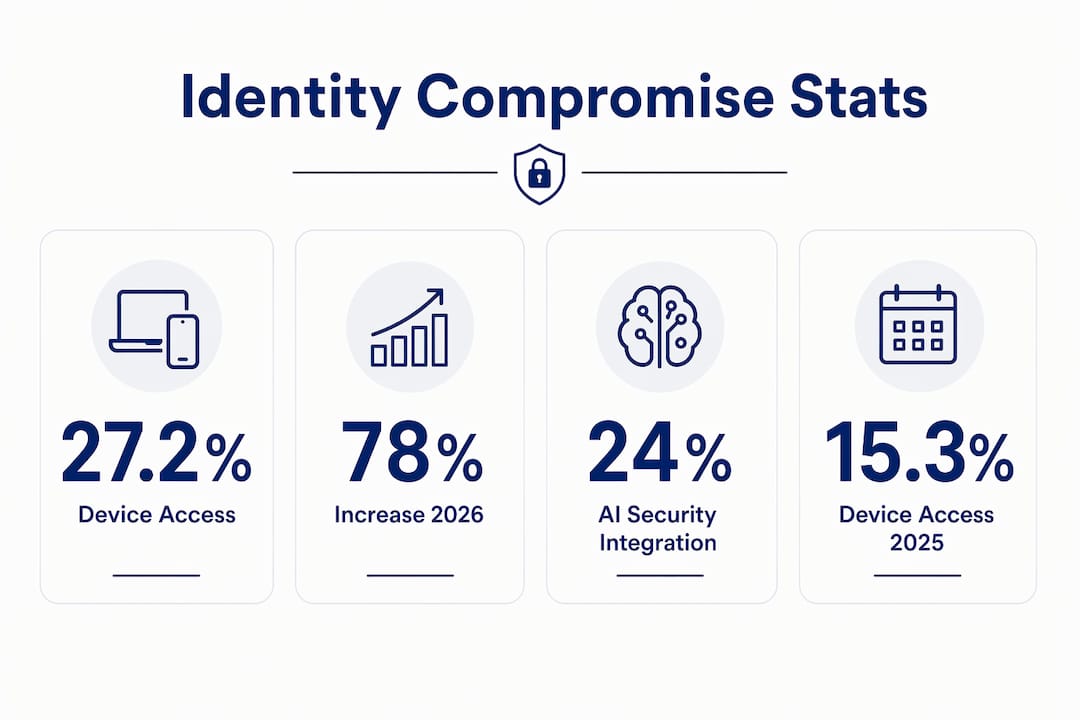
Unauthorised device access rose 78% in 2026, climbing from 15.3% to 27.2% of all reported identity compromises. Adults aged 35–64 are the most affected group. This age bracket tends to hold significant financial assets and professional access credentials, making them high-value targets.
Compromise type | 2025 share | 2026 share | Change |
Unauthorised device access | 15.3% | 27.2% | +78% |
Traditional scams | Higher share | Declining share | Decreasing |
Multi-layered incidents | Emerging | Increasing | Significant rise |
The picture becomes more troubling when you look at multi-layered identity crimes. These are incidents where a victim faces two or more concurrent identity compromises at once, such as a hacked device combined with a fraudulent loan application. Only 9% of victims with financial losses reported any resolution. For victims facing three or more concurrent incidents, the resolution rate is zero.
Financial institutions are often faster at detecting misuse than the victims themselves. That sounds reassuring until you realise it means the fraud is already in motion before you know it has started. Non-financial fraud, such as employment fraud or medical identity theft, lags even further behind in detection and resolution.
The practical implication is clear. Reactive responses are not enough. By the time you receive a fraud alert, the damage may already be layered and complex. Proactive device security, including strong authentication, device monitoring, and regular access reviews, is the only reliable defence.
Pro Tip: Treat your devices like your wallet. Enable multi-factor authentication on every account, review app permissions quarterly, and use a password manager like 1Password or Bitwarden to reduce credential reuse.
What regulatory and platform changes are shaping digital safety in 2026?
Governments are no longer waiting for platforms to self-regulate. The regulatory environment for digital safety has shifted decisively in 2026, with real consequences for schools, businesses, and families.
Twenty-five OECD nations have introduced or are actively considering age restrictions on social media. Australia, the UK, and Canada are among the most active. Australia’s ban on social media for under-16s has attracted global attention as a test case for age-based platform restrictions.
The problem is that blanket bans create their own risks. Evidence from Australia shows that VPN usage among young people has risen sharply as they circumvent restrictions. A ban without digital literacy education simply pushes risky behaviour underground, where it is harder to monitor and address.
Platform-level changes are more promising. Apple’s age-based account settings embed child safety controls directly into the device ecosystem. This reduces reliance on fragmented third-party apps and creates a more consistent safety layer. When safety is built into the platform rather than bolted on, compliance becomes the default rather than the exception.
For business leaders and educators, the regulatory shift creates both obligations and opportunities:
Compliance requirements are tightening around data handling, age verification, and platform accountability
Parental oversight tools are becoming standard features rather than optional add-ons
Privacy trade-offs require careful navigation, particularly where age verification collects sensitive data
Risk-based regulation is emerging as a more effective model than blanket restrictions
The honest truth is that regulation alone will not create a safer digital world. It sets a floor, not a ceiling. The organisations and families that go beyond compliance, building genuine digital literacy and proactive habits, will be far better protected.
How can organisations implement integrated digital safety strategies?
The defining shift in 2026 cybersecurity predictions is the move from feature-based security to integration-based security. Buying more tools does not make you safer. Connecting the tools you have, and measuring their real business impact, does.
Integrated security strategies that unify identity governance, data protection, and operational platforms are delivering measurable resilience improvements. The organisations seeing the best outcomes are not those with the largest security budgets. They are the ones treating security as a business function, not a technical department.
A practical multi-year roadmap for organisations looks like this:
Audit your identity landscape. Map every human and AI agent that has access to your systems. You cannot protect what you cannot see.
Unify your platforms. Fragmented tools create gaps. Consolidate video conferencing, HR systems, and identity management onto integrated platforms where possible.
Prioritise AI anomaly detection. Start with narrow, high-value AI use cases rather than broad automation. Anomaly detection with human review is a proven starting point.
Build quantum readiness into your roadmap. Quantum computing will break current encryption standards within the decade. Begin assessing your cryptographic dependencies now.
Measure business outcomes, not just compliance metrics. Security investments should demonstrate reduced incident rates, faster response times, and lower financial exposure.
For educators, the role of policy in cyber hygiene is directly linked to student and staff safety outcomes. Schools that treat cybersecurity as a cultural practice, rather than an IT problem, see stronger results. That means regular training, clear device policies, and leadership that models safe digital behaviour.
What digital safety measures can families and educators adopt in 2026?
Families and schools sit at the front line of the future of online safety. The habits children form now will shape their digital behaviour for decades. Getting this right matters enormously.
For families, the most effective approach combines practical tools with open conversation. Technology controls without dialogue create resentment and workarounds. Dialogue without controls leaves children exposed. The combination is what works.
Practical steps for families and educators in 2026:
Use platform-native controls first. Apple’s Screen Time, Google Family Link, and similar built-in tools are more reliable than third-party apps and harder for children to circumvent.
Apply age-appropriate content filtering at the router level, not just the device level, so it covers every connected device in the home.
Review your child’s online risks for kids regularly. The threat environment changes quickly, and last year’s conversation may not cover this year’s risks.
Integrate cyber wellness into school curricula, not as a one-off lesson but as an ongoing practice linked to student wellbeing outcomes.
Use AI parenting tools thoughtfully. AI-powered monitoring tools can help, but they require careful privacy calibration to avoid eroding trust with older children.
Schools that connect student cyber awareness to broader wellbeing programmes see stronger engagement and better outcomes. Cyber safety is not a separate subject. It is part of how young people learn to navigate the world responsibly.
For families wanting structured guidance, Cybercompassconsulting’s internet safety for families resource provides a practical 2026 framework that covers everything from device management to age-appropriate conversations about online risk.
Key takeaways
The most urgent digital safety priority in 2026 is closing the gap between knowing about threats and actually acting on them, whether you are a parent, educator, or business leader.
Point | Details |
AI threats are autonomous | Agentic AI and shadow AI require new identity controls, not just updated antivirus software. |
Device hacking leads identity crime | Unauthorised device access rose 78% in 2026, overtaking scams as the top compromise method. |
Multi-layered incidents are hardest to resolve | Victims with three or more concurrent identity incidents report zero resolution success. |
Regulation alone is insufficient | Social media bans increase VPN use without digital literacy education to support them. |
Integration beats feature accumulation | Unified security platforms with measurable business outcomes outperform collections of disconnected tools. |
Where I think digital safety is actually heading
I have spent a long time watching organisations respond to security threats, and the pattern rarely changes. A new threat emerges, panic sets in, a tool gets purchased, and the underlying behaviour stays the same. What I am seeing in 2026 feels different, though. The scale of AI-driven threats is forcing a genuine reckoning.
The organisations I find most impressive are not the ones with the biggest budgets. They are the ones that have accepted an uncomfortable truth: most security failures are human failures. A phishing email works because someone clicks it. A device gets compromised because someone reused a password. No amount of AI-powered detection fixes that without addressing the human layer.
What gives me genuine hope is the growing recognition that cyber wellness and cybersecurity are the same conversation. Schools that teach digital resilience, families that talk openly about online risks, and businesses that treat security culture as a leadership responsibility are all building the same thing. They are building people who are harder to manipulate and faster to respond.
The regulatory wave is messy and imperfect. Blanket bans create new problems. But the underlying intent, that platforms should be accountable and that children deserve protection, is right. The challenge is building regulation that is nuanced enough to work. That requires evidence, patience, and a willingness to revise what is not working.
My honest advice: do not wait for a perfect policy or a perfect tool. Start with your people. Invest in awareness, build proactive habits, and measure what actually changes. The technology will keep evolving. The human capacity to learn and adapt is the only constant worth betting on.
— Jemma
How Cybercompassconsulting supports your digital safety in 2026
Cybercompassconsulting works with schools, small businesses, and corporate teams to build cyber wellness programmes grounded in behavioural science and real-world evidence. The approach goes well beyond compliance checklists.
For schools, the Cyber Wellness School Program offers virtual consultations that help educators build lasting safety cultures, not just one-off awareness days. For business leaders, the SME business programme connects cybersecurity investment directly to measurable organisational outcomes. Both programmes are built around the understanding that technology alone does not create safety. People do. If you are ready to build a programme that actually sticks, book a consultation online and start with a conversation.
FAQ
What is the biggest digital safety threat in 2026?
Unauthorised device access is the leading cause of identity compromise in 2026, rising 78% to affect 27.2% of reported incidents. AI-powered autonomous attacks represent the fastest-growing emerging threat category.
How does agentic AI create new cybersecurity risks?
Agentic AI refers to software agents that act independently on behalf of users, often with access credentials that legacy identity management systems cannot properly control or monitor. Forrester identifies agent-specific IAM controls as a critical 2026 security priority.
Do social media bans actually protect children online?
Blanket bans show limited effectiveness on their own. Evidence from Australia shows that young people increase VPN usage to circumvent restrictions, which means bans without accompanying digital literacy education can push risky behaviour into less visible spaces.
How can families improve digital safety at home in 2026?
Use platform-native controls like Apple Screen Time or Google Family Link, apply content filtering at the router level, and combine technology controls with regular, open conversations about online risks and healthy digital habits.
What does an integrated cybersecurity strategy look like for businesses?
An integrated strategy unifies identity governance, data protection, and operational platforms rather than accumulating disconnected tools. KPMG and Forrester both identify measurable business outcomes, not just compliance metrics, as the defining marker of effective 2026 security programmes.
Recommended
Comments