Understanding preventive cybersecurity: a 2026 guide
- jemmarenshaw
- Jun 19
- 7 min read
Preventive cybersecurity is defined as the proactive implementation of controls designed to stop cyber threats before they reach your systems or data. Unlike reactive approaches that respond after a breach, prevention works by reducing the attack surface, blocking known threat vectors, and building human resilience before any incident occurs. Key measures include multi-factor authentication (MFA) with FIDO hardware keys, phishing simulation training, and default-deny security models. The stakes are real: the global average breach cost sits at $4.45 million in 2026, yet organisations with awareness programmes and incident response plans save roughly $1.5 million per breach. Understanding preventive cybersecurity is not optional for anyone serious about digital safety.
What are the essential preventive cybersecurity best practices?
Preventive security measures work best when they address both technology and human behaviour at the same time. No single tool closes every gap, but some controls deliver far greater returns than others.
1. Deploy MFA with hardware-based FIDO keys

MFA with FIDO hardware keys is the single most effective preventive measure available today. Weak passwords and phishing remain the leading causes of breaches, with incidents costing up to $10.22 million per event in the United States. Hardware keys eliminate credential theft because the authentication token never leaves the physical device. Passkeys offer a software-based alternative where hardware keys are impractical.
2. Run phishing simulation training with immediate feedback
Phishing simulations reduce click rates significantly, but only when paired with contextual, just-in-time feedback. Generic warnings frustrate users and produce fatigue. The most effective programmes explain the specific technique used in each simulated attack, so employees build genuine recognition skills rather than just anxiety. Coupling simulations with contextual feedback maximises learning retention and sustained vigilance.
3. Adopt a default-deny security model
A default-deny model allows only explicitly approved applications and actions to run. Default-deny models significantly reduce ransomware and zero-day threats by removing the assumption of implicit trust. The critical design detail most organisations miss is pairing restrictions with automated self-service approval workflows, so users do not route around controls through shadow IT.
4. Apply least privilege and Zero Trust principles
Zero Trust requires verification for every access request, regardless of where the request originates. NIST 1800-35 confirms that Zero Trust prevents lateral movement by stopping attackers from roaming freely once inside a network. Least privilege access limits the blast radius of any single compromised account.
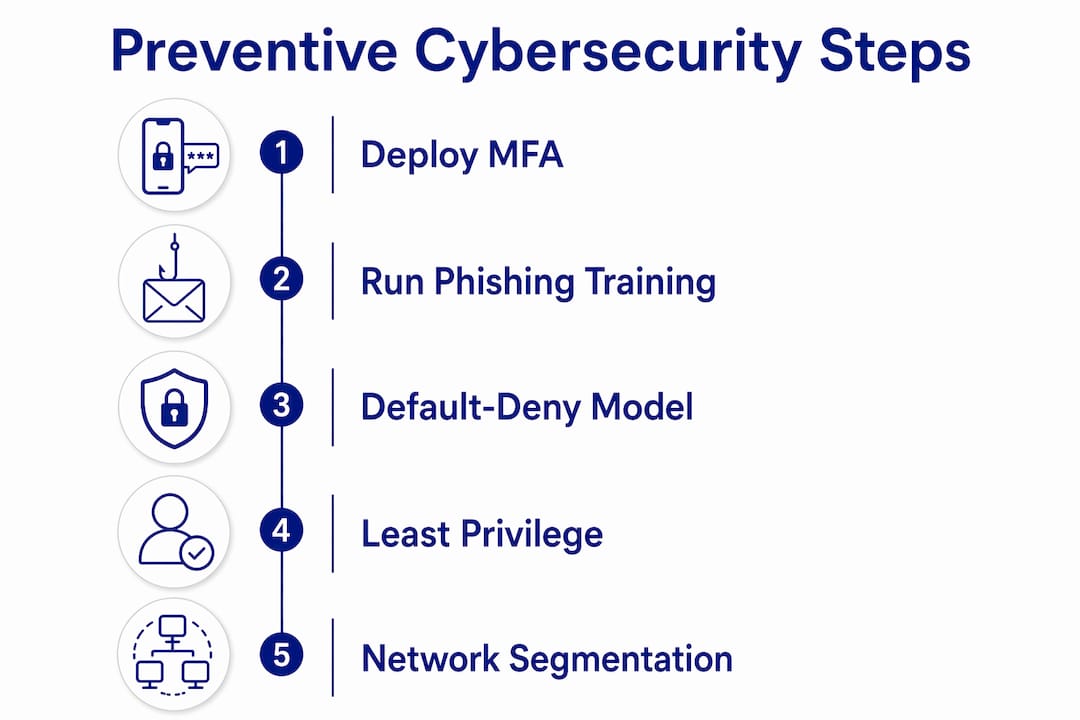
5. Segment networks and secure remote access
Network segmentation contains breaches by isolating critical systems from general traffic. Secure remote access controls, including VPN policies and endpoint health checks, reduce the risk of unmanaged devices becoming entry points.
Pro Tip: Start your MFA rollout with your highest-privilege accounts first. Administrators and finance staff are the most targeted, so protecting them first delivers the greatest immediate risk reduction.
How does preventive cybersecurity compare with detective and preemptive security?
These three terms are often used interchangeably, but they describe genuinely different approaches. Understanding the distinction helps you build a more complete defence.
Security type | Core focus | Primary mechanism | Best suited for |
Preventive | Stop threats before entry | MFA, default-deny, least privilege | Reducing attack surface |
Detective | Identify threats after entry | SIEM, intrusion detection, log analysis | Incident response and forensics |
Preemptive | Disrupt attacker reconnaissance | AI-driven exposure management, rotating network configs | High-risk and critical infrastructure |
Preventive security reduces the attack surface and blocks threats at the perimeter or at the point of access. Detective security assumes some threats will get through and focuses on finding them quickly. Preemptive security goes a step further by using AI-powered continuous assessment to identify and remediate exposures before any compromise occurs, reducing attacker breakout time from days to seconds.
Organisations often mistake preventive for preemptive security. The latter uses AI to actively disrupt attacks before they start, complementing but not replacing prevention. Relying on detection alone is insufficient for high-risk environments because detection always involves some delay, and in that window, damage accumulates. The most resilient organisations layer all three approaches, using prevention as the foundation.
What evidence supports the effectiveness of preventive measures?
The data on preventive cybersecurity is compelling, and it goes well beyond anecdote.
Organisations running monthly phishing awareness training saw user click rates drop from 25–35% to 5–10% within 12 months. Mature programmes pushed that figure below 3%. For a 200-person organisation spending $15,000–$40,000 annually on training, the return is $37 saved for every $1 invested in breach cost mitigation. That is not a marginal gain. It is a structural shift in risk exposure.
“Awareness training is often misunderstood as a compliance checkbox. It is actually a measurable risk control that improves decision-making skills under pressure.” — Lorikeet Security
The cost savings extend beyond training. Organisations with tested incident response plans and security awareness programmes save approximately $1.5 million per breach compared to those without. AI and automation further reduce the breach lifecycle by roughly 80 days, compressing the window in which attackers can cause harm.
Human behaviour sits at the centre of these results. Employees who perceive threats as personally relevant practise better cyber hygiene and respond more effectively to simulated attacks. Framing threats as tangible realities rather than abstract policy obligations changes how people engage. This is why Cybercompassconsulting integrates behavioural science into its training programmes rather than relying on compliance-driven checklists alone.
How to implement preventive cybersecurity in your organisation
Knowing the principles is one thing. Putting them into practice is where most organisations struggle. Here is a grounded approach that works for teams of any size.
Start with access controls
Deploy MFA immediately across all user accounts, prioritising administrators, finance, and HR.
Replace SMS-based MFA with FIDO hardware keys or passkeys wherever possible, as SMS codes remain vulnerable to SIM-swapping attacks.
Audit and reduce user permissions to enforce least privilege. Remove standing access that is not actively needed.
Implement a Zero Trust framework that requires continuous verification rather than assuming trust based on network location.
Build a phishing training programme that sticks
Run simulated phishing campaigns monthly, varying the techniques used so employees encounter realistic and evolving scenarios.
Deliver immediate, specific feedback when a user clicks a simulated link. Explain the exact technique used, not just a generic “you failed” message.
Increase simulation difficulty progressively as your team improves. Stagnant scenarios produce stagnant results.
Track click rates over time and report them to leadership as a risk metric, not a punishment tool.
Harden your technical environment
Apply default-deny policies using tools like ThreatLocker to restrict unapproved applications from executing.
Segment your network so that a breach in one area cannot cascade across the whole environment.
Enforce endpoint health checks before granting remote access. Unpatched or unmanaged devices are a common entry point.
Build a security culture, not just a policy
A supportive security culture drives better phishing resilience because employees who feel psychologically safe are more likely to report suspicious activity rather than hide mistakes. Make it easy to report. Celebrate near-misses. Treat every reported phishing attempt as a win, not a failure.
Pro Tip: When rolling out a cyber wellness plan for your organisation, involve frontline staff in designing the training scenarios. People engage far more deeply with threats that reflect their actual daily workflows.
Key takeaways
Preventive cybersecurity is the most cost-effective defence available, delivering measurable reductions in breach rates and costs when MFA, phishing training, and default-deny controls are implemented together.
Point | Details |
MFA is the highest-return control | Hardware-based FIDO keys eliminate credential theft and deliver immediate risk reduction. |
Phishing training must include feedback | Simulations paired with contextual feedback reduce click rates below 3% in mature programmes. |
Default-deny stops ransomware | Allowing only approved applications blocks zero-day and ransomware threats at the source. |
Preventive and preemptive are different | Preemptive security uses AI to disrupt attacks before entry; it complements but does not replace prevention. |
Culture amplifies every technical control | Employees who see threats as personally relevant practise stronger cyber hygiene across the board. |
Why I think we are still getting prevention wrong
I have spent over 35 years watching organisations invest in cybersecurity tools and still get breached. The pattern is almost always the same. The technology is sound, but the human layer is treated as an afterthought.
What troubles me most is how often “awareness” is confused with “skill.” Telling someone that phishing exists does not make them better at spotting it under pressure. Skill comes from practice, from repeated exposure to realistic scenarios, and from understanding why a particular email looked legitimate. That is a training design problem, not a technology problem.
I also see organisations resist default-deny models because they fear the friction. That fear is understandable. Nobody wants to field calls from staff who cannot open a file. But balanced zero trust implementations that include automated self-service approvals resolve most of that friction within weeks. The organisations that push through the initial discomfort come out the other side with a fundamentally stronger posture.
The honest truth is that 100% preventive security is a myth. The most effective teams combine preventive and preemptive controls, adapting dynamically as attacker strategies evolve. Prevention is the foundation. Preemptive AI-driven techniques are the next layer. And human skill is the thread that holds it all together.
We cannot keep treating cybersecurity as a technology purchase. It is a behaviour change programme that happens to involve technology.
— Jemma
How Cybercompassconsulting helps you build real prevention
If you have read this far and you are wondering where to start, that is exactly the conversation Cybercompassconsulting is built for.
Cybercompassconsulting brings over 35 years of experience in cyber wellness, combining behavioural science with practical security strategy to help schools, SMEs, and corporate teams build genuine preventive security cultures. Whether you need a corporate cybersecurity programme for your workforce, tailored training for an SME business, or a structured plan for a school community, the team designs solutions around your people, not just your systems. The goal is not compliance. It is resilience. Book a consultation to start building a preventive security posture that actually holds.
FAQ
What is preventive cybersecurity?
Preventive cybersecurity is the proactive implementation of controls, including MFA, phishing training, and default-deny models, designed to stop threats before they reach your systems. It focuses on reducing attack surface and blocking threats at the point of entry rather than responding after a breach.
How does MFA prevent cyber attacks?
MFA with FIDO hardware keys eliminates credential theft by requiring physical possession of the authentication device. Because the token never leaves the hardware key, stolen passwords alone cannot grant access.
How often should phishing training run?
Monthly phishing simulations are the standard for effective programmes. Organisations running monthly training see click rates drop from 25–35% to below 5% within 12 months, with mature programmes reaching below 3%.
What is the difference between preventive and preemptive cybersecurity?
Preventive security blocks known threats before entry using controls like MFA and default-deny policies. Preemptive security uses AI to identify and neutralise attacker footholds before any compromise occurs, reducing breakout time from days to seconds.
Is preventive cybersecurity enough on its own?
No. A 100% preventive posture is not achievable against sophisticated attackers. The most resilient organisations layer preventive controls with detective monitoring and preemptive AI-driven techniques to adapt as threats evolve.
Recommended
Comments