What is cyber behaviour change: a practical guide
Cyber behaviour change is defined as the active process of moving beyond security awareness to embed secure habits into daily digital actions. It is not a one-time training event. It is a deliberate, ongoing effort to modify how individuals and organisations respond to digital threats, using frameworks like COM-B and the Fogg Behaviour Model to influence actions at scale. Understanding cyber behaviour change matters because most breaches are not caused by technical failures. They are caused by people. Cybercompassconsulting has spent over 35 years working at this intersection of human behaviour and digital safety, and the evidence is clear: knowledge alone does not protect anyone.
What is cyber behaviour change and why does it matter?
Cyber behaviour change is the deliberate modification of individual and organisational actions to make secure choices habitual and automatic. The standard industry term for this field is “security behaviour change,” and it sits within the broader discipline of behavioural science applied to cybersecurity. The goal is not compliance. The goal is culture.
Traditional cybersecurity focused almost entirely on technology. Firewalls, antivirus software, and password policies were the primary defences. But human psychology remains the most exploited vulnerability, and a 41-study meta-analysis confirms that psychological factors directly determine security effectiveness. That finding should stop us in our tracks. It means that no amount of technical infrastructure compensates for a workforce that clicks phishing links under pressure.
The impact of cyber behaviour extends far beyond individual mistakes. When one person shares a password, an entire organisation is exposed. When a child clicks an unsafe link, a family’s data is at risk. Cyber behaviour and online safety are inseparable, and addressing one without the other leaves dangerous gaps.

How do behavioural science frameworks explain cyber behaviour change?
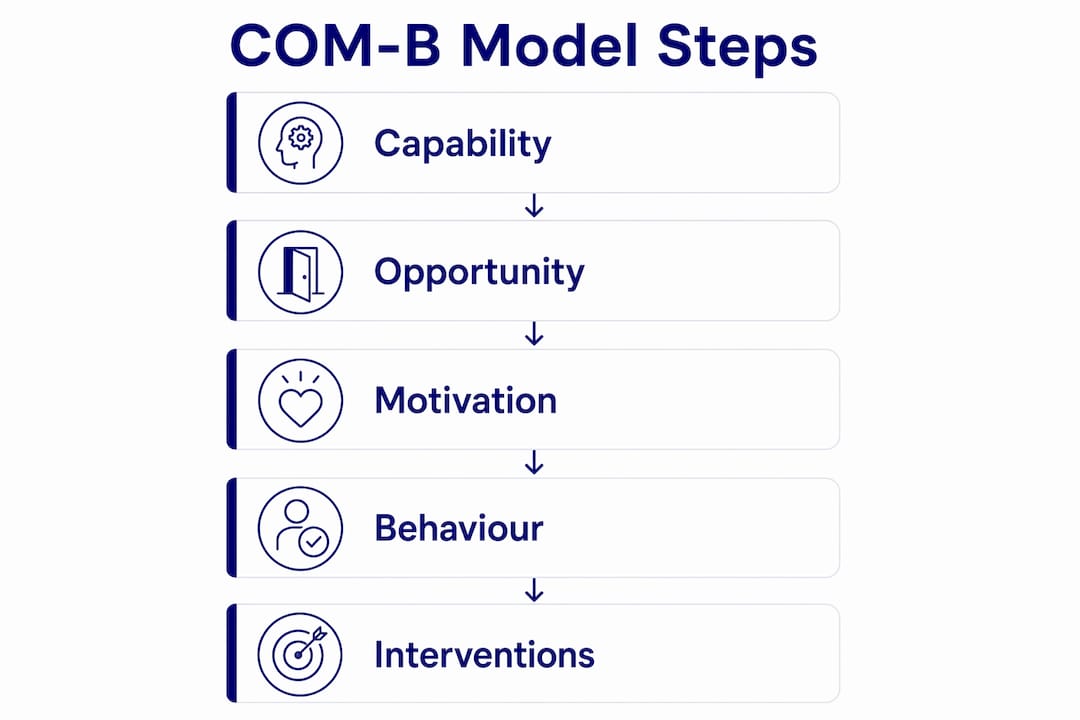
The COM-B model diagnoses behaviour through three components: capability, opportunity, and motivation. All three must align for a behaviour to occur. If someone lacks the capability to recognise a phishing email, motivation alone will not save them. If the opportunity to act securely is blocked by a clunky system, even capable and motivated people will take shortcuts.
COM-B component | What it means | Intervention type |
Capability | Knowledge and skills to act securely | Education, training, skill-building |
Opportunity | Environment and systems that enable secure action | Enablement, nudges, redesign |
Motivation | Desire and habit driving secure choices | Persuasion, incentives, social norms |
The Behaviour Change Wheel builds on COM-B by identifying nine intervention functions, including education, enablement, and persuasion, that guide targeted programme design. This is not abstract theory. It gives practitioners a concrete map for deciding which lever to pull for which problem. A team that lacks knowledge needs education. A team that knows the risks but faces friction in the system needs enablement.
Cybersecurity is fundamentally human-focused. Designs that work with natural human tendencies, rather than against them, produce lasting results. That is the core insight that separates effective cyber behaviour change from generic awareness campaigns.
Pro Tip: Before designing any behaviour change programme, run a COM-B assessment to diagnose which component is the actual barrier. Treating a motivation problem with more training wastes time and goodwill.
Why does traditional security training fall short?
Annual security training is the dominant approach in most organisations. It is also largely ineffective. A single yearly session cannot compete with the daily volume of threats employees face. The information decays quickly, and the format rarely connects to real work contexts.
The shift to real-time, context-aware nudges changes this picture significantly. A case study involving 9,000 employees showed that role-specific video messaging and real-time behavioural nudges reduced high-risk actions measurably. That is not a marginal improvement. It represents a fundamentally different approach to reducing human error in cybersecurity. Similarly, targeted short video messaging correlates with faster operating system patching and reduced vulnerabilities, outperforming email-based training by a clear margin.
The advantages of modern behavioural interventions over traditional training include:
Real-time delivery: Nudges arrive at the moment of risk, not months before it.
Role-specific content: Messages match the actual threats each person faces in their job.
Short format: Brief videos and micro-messages fit into workflows without disrupting them.
Measurable outcomes: Behavioural data shows what changed, not just who clicked “complete.”
Iterative design: Programmes adapt based on what the data reveals about ongoing risk.
Pro Tip: Replace your next annual training session with a series of two-minute role-specific videos delivered monthly. The retention rate and behaviour change will be noticeably stronger.
What psychological and social factors shape cyber behaviour?
Attackers do not target systems first. They target people. Social engineering, phishing, and pretexting all exploit predictable human responses: trust, urgency, and cognitive overload. When someone is overwhelmed with tasks, their capacity to evaluate a suspicious email drops sharply. That is not a character flaw. It is a documented psychological reality.
Cognitive overload is one of the most underestimated risks in cybersecurity. When security measures add friction to already demanding workflows, people find workarounds. Employees often bypass new security measures when those measures feel more disruptive than the threat itself. Sustainable compliance requires that the perceived benefit of acting securely outweighs the perceived inconvenience. That balance is rarely achieved through policy alone.
Influence type | Examples | Effect on behaviour |
Individual | Cognitive overload, fear, habit | Increases error rate and avoidance |
Social | Peer norms, group identity, leadership modelling | Shapes what feels “normal” to do |
Organisational | Culture, policy, system design | Determines whether secure choices are easy or hard |
Social norms and leadership modelling influence security culture far more than individual instruction alone. When leaders visibly practise secure habits, and when security champions within teams reinforce those norms, behaviour shifts faster and sticks longer. Group dynamics matter enormously. Shifting the perception of what the group considers normal is one of the most powerful levers available. Social identity shapes behaviour at a group level, and that insight changes how we design interventions entirely.
How can individuals and organisations build lasting cyber behaviour change?
Lasting change requires a structured approach, not a single event. The COM-B model and Behaviour Change Wheel together provide a clear sequence for designing interventions that actually work.
Assess the current state. Run a COM-B diagnostic to identify whether the primary barrier is capability, opportunity, or motivation. Do not assume. Ask, observe, and measure.
Select the right intervention type. Use the Behaviour Change Wheel to match the diagnosed barrier to an appropriate response. A motivation gap calls for persuasion and social norms work. A capability gap calls for education and skill-building.
Design for the context. Nudges and prompts work best when they appear at the moment of decision. A pop-up warning before an employee sends sensitive data outside the organisation is more effective than a training session held six months earlier.
Use personalised dashboards. Showing individuals their own security behaviour data creates accountability without shame. People respond to seeing their own patterns.
Embed social proof. Highlight what secure colleagues are doing. Phrases like “most people in your team use two-factor authentication” activate group norm psychology and encourage adoption.
Balance security and usability. Security measures perceived as too disruptive lead to avoidance. Every new control should be tested for its impact on workflow before it is rolled out broadly.
Review and iterate. Behaviour change is never finished. Threats evolve, teams change, and habits erode. Build in regular review cycles and treat the programme as a living system.
For schools, the student cyber awareness workflow offers a practical starting point for embedding these principles in educational settings. For corporate teams, the same principles apply, but the context and role-specific risks differ significantly.
Key takeaways
Cyber behaviour change is the most direct path to reducing human-driven cybersecurity risk, and it requires aligning capability, opportunity, and motivation simultaneously.
Point | Details |
Definition is precise | Cyber behaviour change is the active process of embedding secure habits, not just raising awareness. |
COM-B drives design | Diagnose capability, opportunity, and motivation before selecting any intervention. |
Real-time nudges outperform training | Role-specific, contextual prompts reduce high-risk actions more effectively than annual sessions. |
Social factors are decisive | Leadership modelling and peer norms shape security culture faster than individual instruction. |
Usability must be protected | Security measures that create too much friction produce workarounds, not compliance. |
My honest view on where this field is heading
I have watched organisations pour money into annual compliance training for years, and I have watched it fail just as consistently. The frustrating part is that the evidence for a better approach has existed for a long time. COM-B, the Behaviour Change Wheel, real-time nudges. These are not new ideas. What is new is the willingness of some organisations to actually use them.
What still gets missed most often is the social dimension. We design programmes for individuals and then wonder why the culture does not shift. Culture is not the sum of individual behaviours. It is the product of what a group considers normal. Until leaders model secure habits visibly, and until security champions are empowered to reinforce those norms within their teams, individual training will always hit a ceiling.
The other thing I keep coming back to is the usability trap. When security feels like punishment, people route around it. I have seen this in schools, in small businesses, and in large corporates. The solution is not to make security easier to ignore. It is to design systems where the secure choice is also the easiest choice. That requires collaboration between security teams and the people who actually use the systems every day.
Behaviour change is iterative. There is no finish line. The threat environment shifts, teams change, and habits erode without reinforcement. The organisations that treat cyber behaviour change as an ongoing discipline, rather than a project with a completion date, are the ones building genuine resilience.
— Jemma
How Cybercompassconsulting supports your cyber behaviour change
Cybercompassconsulting works with families, schools, SMEs, and corporate teams to build the kind of cyber safety culture that lasts. The approach is grounded in behavioural science and shaped by over 35 years of experience in digital safety and human behaviour.
Programmes cover everything from cyber wellness planning and virtual consultations to school-based digital safety education and workplace behaviour change initiatives. Whether you are a parent trying to build safer habits at home or a business leader looking to reduce human error across your organisation, Cybercompassconsulting offers tailored consulting services designed around your specific context. The goal is always the same: make secure behaviour the default, not the exception.
FAQ
What is cyber behaviour change in simple terms?
Cyber behaviour change is the process of turning security knowledge into secure habits. It uses frameworks like COM-B to identify and address the real barriers stopping people from acting safely online.
Why is cyber behaviour change important for organisations?
Human error drives the majority of cybersecurity incidents. Addressing behaviour through targeted, evidence-based interventions reduces risk far more effectively than technical controls alone.
What are some examples of cyber behaviour change in practice?
Real-world examples include real-time nudges that warn employees before risky actions, role-specific short video training, personalised security dashboards, and security champions who reinforce group norms within teams.
How does the COM-B model apply to cybersecurity?
COM-B diagnoses whether a behaviour gap is caused by lack of capability, limited opportunity, or insufficient motivation. Each component requires a different intervention, and all three must align for lasting change to occur.
How long does cyber behaviour change take to show results?
Measurable results can appear within weeks when real-time nudges and role-specific content replace annual training. Sustained culture change, however, requires ongoing reinforcement and regular programme review.
Recommended
Comments