What is digital risk management: a guide for families, schools, and small businesses
Digital risk management is the continuous, proactive process of identifying, assessing, and controlling risks that arise from adopting and using digital technologies. Unlike traditional IT risk management, which focuses on protecting existing infrastructure, digital risk management covers broader business and social impacts: customer trust, operational continuity, and regulatory compliance.

The risks facing Australian families, schools, and small businesses are not purely technical. They are human, social, and economic. A child sharing too much online, a school staff member clicking a phishing link, a small business owner using an unsecured app because the approved one is too slow. These are the real vulnerabilities.
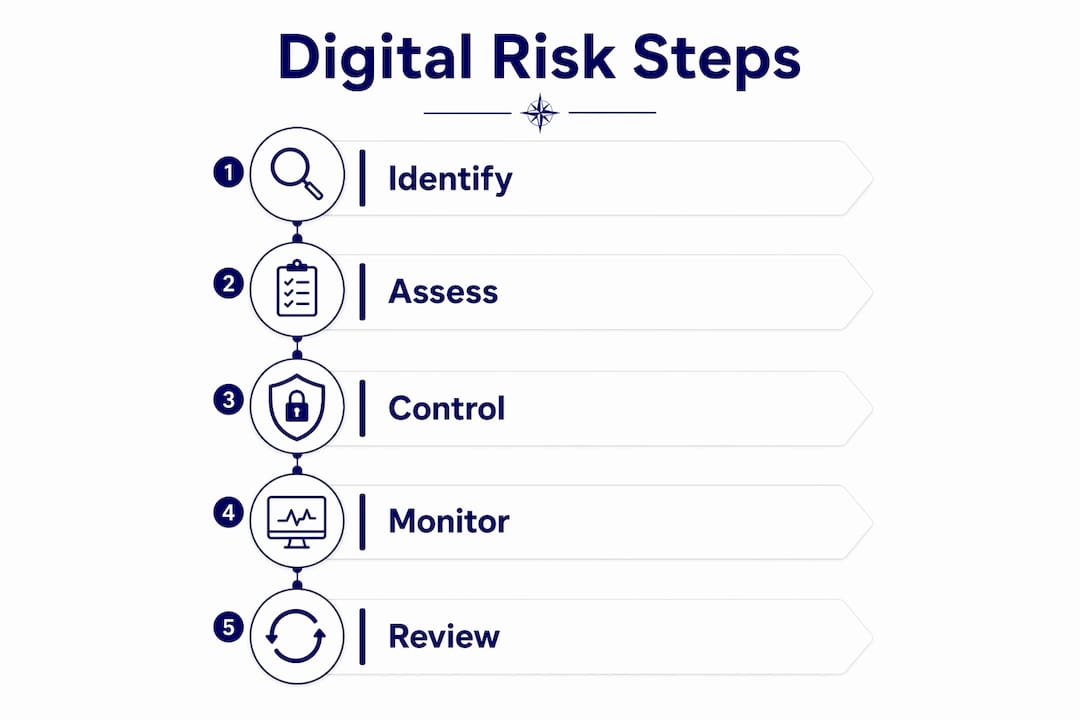
A mature digital risk programme follows five steps:
Identify exposed assets: every device, account, and data store in your environment
Create an incident response plan: so you know exactly what to do when something goes wrong
Reduce your attack surface: remove unnecessary access points and permissions
Monitor network access actively: watch for unusual behaviour in real time
Continuously monitor your attack surface: threats evolve, and so must your oversight
The goal is not total risk elimination. It is confident control over the risks that matter most.
How to manage digital risk in everyday settings
Practical risk management rarely fails because of missing technology. It fails because people find workarounds. When security policies feel too hard, human behaviour and policy fatigue lead to shadow IT: staff using personal apps, students bypassing school filters, parents ignoring router settings. The fix is embedding security into the easiest path, not bolting it onto an already-busy day.
Run a digital risk assessment first. Map every device and account your household, school, or business uses before deciding what to protect.
Apply access controls by role. Children, students, and junior staff need different permissions than administrators. Least-privilege access limits damage when credentials are compromised.
Build security into daily routines. Password managers like Bitwarden, automatic software updates, and multi-factor authentication cost almost nothing and remove the most common entry points.
Address the migration gap. When you upgrade systems or switch apps, legacy permissions and forgotten credentials create windows of vulnerability. Audit access every time you change platforms.
Train people, not just systems. Regular, short training sessions outperform annual compliance tick-boxes. Scenario-based learning, where someone actually practises spotting a phishing email, builds genuine skill.
Monitor continuously. Threats shift quickly, especially as digital transformation accelerates security incidents. Set up alerts for unusual logins or data transfers rather than reviewing logs monthly.
Review and adapt. A digital risk assessment is not a one-time event. Quarterly reviews aligned with any technology changes keep your posture current.
Pro Tip: Make the secure option the convenient option. If your school’s approved file-sharing tool is slower than a personal Google account, staff will use the personal account. Solve the friction, and you solve most of the shadow IT problem.
Why digital risk is an economic and social challenge, not just a technical one
The OECD frames digital security risk as an economic and social challenge, not a purely technical one. Leaders who treat it as an IT department problem consistently underinvest in the human and organisational factors that drive most incidents.
“Digital security risk management includes the actions taken by individuals and organisations to address this risk while maximising economic and social opportunities. Public policies should promote digital security risk management throughout the economy and society to cultivate trust and bolster resilience in the digital transformation era.” — OECD
Risk management done well is not a barrier to growth. It is what makes confident innovation possible. A fractal approach assesses risk simultaneously at the user, team, infrastructure, and vendor levels, preventing the visibility silos where incidents hide. For a small business or school, that means not just securing the server, but also the contractor’s laptop and the parent volunteer’s login.
Adaptable, dynamic controls outperform static ones in fast-moving environments like cloud platforms and AI tools. The mindset shift from “we must prevent everything” to “we maintain confident control and recover quickly” is what separates organisations that handle incidents well from those that are blindsided by them.
What Australian regulations require you to know
Australian families, schools, and small businesses operate under a clear set of legal obligations that shape how digital risk must be managed.
Privacy Act 1988: Organisations handling personal information must take reasonable steps to protect it. Schools holding student records and small businesses storing customer data both fall under this obligation.
Australian Signals Directorate (ASD) Essential Eight: The ASD’s Essential Eight framework provides a prioritised set of mitigation strategies, from application control to regular backups, that reduce the most common attack vectors.
Children’s data protections: Schools face specific obligations around student data, including restrictions on third-party sharing and requirements for parental consent in many contexts.
Notifiable Data Breaches scheme: Organisations covered by the Privacy Act must notify affected individuals and the Office of the Australian Information Commissioner when a data breach is likely to cause serious harm.
Continuous compliance review: Embedding cybersecurity into digital transformation processes, rather than treating compliance as a separate audit, keeps obligations current as technology changes.
Regulatory adherence and good risk management are not separate tasks. A well-run digital risk programme naturally produces the documentation, access controls, and monitoring records that compliance requires.
How to engage families, students, and staff in building a safer digital culture
Education is where most digital risk programmes either succeed or quietly collapse. Awareness without behaviour change is just information. The goal is genuine habit formation, and that requires more than a once-a-year webinar.
Tailor content to the audience. A workshop for primary school students looks nothing like one for a small business owner. Pitch the language, examples, and stakes to the people in the room.
Use real scenarios. Practising what to do when a suspicious link arrives in a school email is more effective than reading a policy document about phishing.
Involve leadership visibly. When a school principal or business owner models good digital habits, staff and students follow. Leadership drives digital safety culture more than any policy document.
Reduce policy fatigue through design. Fewer, clearer rules that are easy to follow beat comprehensive policy manuals that nobody reads.
Iterate based on feedback. Ask staff and students what feels confusing or burdensome, then adjust. Engagement improves when people feel heard.
Celebrate progress. Recognising good digital habits, rather than only punishing breaches, shifts the culture from fear-based compliance to genuine ownership.
Cybercompassconsulting brings over 35 years of experience integrating behavioural science with cybersecurity, offering tailored programmes for school communities and families that go well beyond technical checklists.
Cybercompassconsulting’s SME business programmes are built for exactly this challenge: practical, people-centred digital risk management that fits the reality of running a small business or school in Australia.
Key takeaways
Digital risk management succeeds when it treats human behaviour and organisational culture as seriously as technical controls.
Point | Details |
Definition and scope | Digital risk management is a continuous process covering trust, compliance, and operations, not just IT infrastructure. |
Five-step framework | Identify assets, plan incident response, reduce attack surface, monitor access, and continuously review your posture. |
Human behaviour is the biggest risk | Policy fatigue and shadow IT create more incidents than technical failures; embed security into easy daily paths. |
Australian legal obligations | The Privacy Act, ASD Essential Eight, and Notifiable Data Breaches scheme set clear requirements for schools, families, and small businesses. |
Confident control, not elimination | The realistic goal is maintaining control and recovering quickly, not preventing every possible incident. |
Recommended
Comments