Why focus on cyber psychology for online safety
Cyber psychology is the scientific study of how human thought, emotion, and behaviour are shaped by digital technology and online environments. Understanding why focus on cyber psychology matters is not an abstract academic question. Attackers today exploit human psychology more than technical flaws, making psychological literacy as critical as any firewall. For individuals, educators, and mental health professionals, this field offers the clearest path to safer, healthier digital lives. Cybercompassconsulting has built its entire practice on exactly this premise, integrating behavioural science with practical digital safety strategies.
Why focus on cyber psychology to understand digital vulnerabilities?
The psychological mechanisms behind cyber threats are specific, well-documented, and deeply exploitable. Cognitive overload doubles the risk of clicking malicious phishing links. That single finding reframes the entire conversation about why people fall for scams. It is not carelessness. It is a predictable neurological response to information saturation.
Attackers design phishing campaigns to force what psychologists call “System 1” thinking, the fast, intuitive mode of cognition that bypasses careful analysis. When your inbox is flooded, your brain defaults to gut reactions. Analytical “System 2” thinking, the slow, deliberate kind, gets crowded out. This is not a character flaw. It is how human cognition works under pressure, and skilled attackers know it.

Emotional triggers compound the problem. Fear, urgency, and authority are the three most commonly weaponised emotions in social engineering. A message that reads “Your account will be suspended in 24 hours” is not just alarming. It is architecturally designed to short-circuit rational evaluation. Confirmation bias and optimism bias add further layers, leading people to dismiss warning signs that contradict their existing assumptions or to believe “it won’t happen to me.”
Understanding these mechanisms is the foundation of any credible digital safety approach. Without it, training programmes address symptoms rather than causes.
Pro Tip: When designing awareness training, present phishing examples during low-pressure, low-distraction conditions. Cognitive load at the time of training directly affects how well lessons transfer to real-world situations.
What role does cyber psychology play in digital mental health?
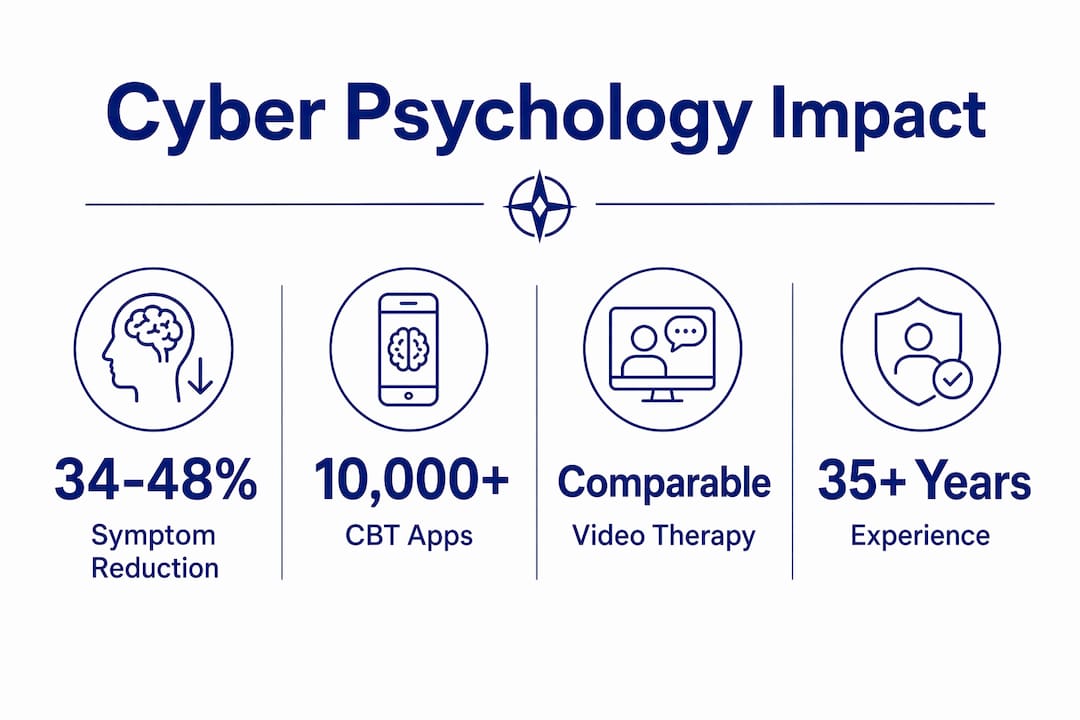
The importance of cyber psychology extends well beyond cybersecurity. Clinical cyberpsychology, the application of psychological science to digital therapeutic tools, is reshaping how mental health care reaches people. Digital CBT tools reduce depression and anxiety symptoms by 34–48% in clinical trials. That is a clinically meaningful outcome, not a marginal improvement.
Over 10,000 CBT-based conversational AI applications are now available globally. The sheer scale signals a structural shift in how mental health support is delivered. For mental health professionals, this creates both an opportunity and a responsibility to understand the psychological dynamics of digital therapeutic relationships.
Video-delivered psychotherapy produces outcomes comparable to in-person treatment, with a meta-analysed effect size difference of just 0.04. That number matters because it dismantles the assumption that digital therapy is a lesser substitute. It is a genuinely equivalent modality for most conditions.
Modality | Efficacy evidence | Key benefit |
Digital CBT apps | 34–48% symptom reduction | Accessible at scale, 24/7 availability |
Video psychotherapy | Effect size difference of 0.04 vs in-person | Removes geographic and mobility barriers |
Hybrid models | Combines both | Balances technology with human connection |
Hybrid models, those that blend digital tools with human therapeutic contact, are particularly effective at overcoming access barriers. Rural communities, people with mobility limitations, and those facing stigma around in-person help-seeking all benefit from this approach. Cyber psychology provides the theoretical framework that makes these models work safely and ethically.
Pro Tip: Mental health professionals integrating digital tools should assess clients’ digital literacy and comfort with technology before recommending app-based interventions. Therapeutic alliance still predicts outcomes, even in digital formats.
Why is human behaviour central to cybersecurity strategy?
Technology alone does not stop cyber threats. Gartner advises CISOs to integrate cyberpsychological competence alongside technical training, recognising that human behaviour is the most consequential variable in any security system. This is not a soft recommendation. It is an operational strategy.
Most organisations still treat security training as a compliance exercise. Tick the box, move on. The problem is that compliance-based training triggers a psychological phenomenon called “reactance,” where people resist messages they perceive as controlling or threatening. The harder you push fear-based warnings, the more people disengage. The result is training that actively undermines the behaviour change it is meant to produce.
“Fear-based security messaging is counterproductive. Civic responsibility appeals, framing secure behaviour as something you do for your community, not just yourself, drive deeper and more sustained engagement.” — Dr Victoria Baines, cybersecurity researcher
Nudge theory offers a more effective path. Rather than demanding compliance, nudge-based design makes secure choices the easiest choices. Default password managers, automatic software updates, and friction-free multi-factor authentication all reduce the cognitive effort required to behave securely. Secure habits form when the environment supports them, not when people are lectured into them.
Personality traits also predict risk in ways that job tenure or role level do not. Impulsivity better predicts social engineering susceptibility than years of experience. People analytics, integrating personality, cognitive, and behavioural data, enables proactive identification of at-risk individuals before an incident occurs. Cyberpsychologists also enhance threat detection by identifying behavioural anomalies in real time, flagging unusual patterns that purely technical systems miss.
The key behavioural factors that effective cybersecurity strategies must address include:
Cognitive load management: Reduce information overload in security interfaces and communications.
Emotional regulation: Train people to pause and verify when they feel urgency or fear.
Bias awareness: Help teams recognise confirmation and optimism bias in their own risk assessments.
Nudge design: Build environments where secure behaviour is the path of least resistance.
People analytics: Use behavioural data to identify and support high-risk individuals proactively.
How can educators apply cyber psychology to improve online safety?
Educators and mental health professionals are on the front line of digital wellbeing. The role of cyber psychology in school and community settings is to translate research into programmes that build genuine resilience, not just rule-following. Cybercompassconsulting’s school cyber wellness programmes are built on exactly this model, combining psychological resilience with practical digital safety skills.
Effective cyber wellness education addresses three interconnected areas. First, it builds self-awareness around digital habits, helping students and families recognise how screen time, social media use, and online interactions affect mood, attention, and decision-making. Second, it teaches specific skills for managing online risks, from recognising manipulation tactics to understanding privacy settings. Third, it cultivates a sense of community responsibility, the understanding that online behaviour affects real people.
Reducing cyberbullying requires more than rules. It requires empathy development, perspective-taking skills, and an understanding of how anonymity and distance change the way people treat each other online. Psychological resilience programmes that address these factors show stronger outcomes than policy-only approaches. Families benefit from the same frameworks, and internet safety for families is most effective when it integrates psychological principles rather than relying solely on parental controls.
A practical framework for educators includes:
Assess digital habits first. Use structured reflection tools to help students identify their own patterns before introducing safety concepts.
Teach emotional recognition. Help young people name the feelings that online environments trigger, including excitement, anxiety, and social pressure.
Practise scenario-based learning. Role-play responses to phishing, cyberbullying, and social engineering in low-stakes classroom settings.
Involve families. Cyber wellness education is most durable when it extends into the home environment.
Build community norms. Frame digital safety as a shared responsibility, not an individual burden.
Pro Tip: When running cyber awareness sessions for students, use real examples from platforms they actually use. Abstract scenarios about “email phishing” land poorly with teenagers who communicate primarily through social media and messaging apps.
The role of digital habits in safety is well established. Consistent, psychologically informed education builds the kind of lasting behaviour change that one-off awareness campaigns cannot achieve.
Key takeaways
Cyber psychology is the most direct route to understanding and reducing human vulnerability in digital environments, making it indispensable for safety, mental health, and education.
Point | Details |
Cognitive overload is a weapon | Attackers deliberately overwhelm users to force fast, error-prone decisions. |
Digital therapy is clinically credible | Video and app-based CBT tools match in-person outcomes across most mental health conditions. |
Fear-based training backfires | Civic responsibility messaging drives more sustained secure behaviour than fear appeals. |
Personality predicts risk | Impulsivity is a stronger predictor of social engineering susceptibility than job experience. |
Education needs psychological grounding | Cyber wellness programmes work best when they build emotional resilience, not just rule awareness. |
Why I think we are still underestimating cyber psychology
The field has the evidence. The clinical trials are solid. Gartner has issued the guidance. And yet most organisations and schools are still running the same fear-based, tick-box programmes they were running a decade ago. That gap between what the research says and what actually happens in practice is the thing that keeps me up at night.
What I have seen, working across schools, families, and corporate teams, is that the moment you shift the conversation from “here are the threats” to “here is how your mind works under pressure,” something changes. People stop feeling blamed and start feeling equipped. That shift is not cosmetic. It produces measurably different behaviour.
The hybrid model is where I think the future sits. Not purely digital, not purely human, but a thoughtful combination that meets people where they are. A teenager in a rural town who can access a digital CBT tool at 11 PM is better served than one who has to wait three months for a face-to-face appointment. A corporate team that receives nudge-designed security interfaces will outperform one that sits through an annual compliance lecture.
The uncomfortable truth is that cyber psychology is not a “nice to have” addition to safety programmes. It is the mechanism by which those programmes actually work. Without it, we are building houses without foundations and wondering why they keep falling down. The digital world is not going to slow down and wait for us to catch up. We need to build psychological literacy into every layer of how we teach, protect, and support people online.
— Jemma
Cyber wellness support from Cybercompassconsulting
Cybercompassconsulting brings over 35 years of experience to the intersection of behavioural science and digital safety. Whether you are an educator building a school-wide cyber wellness programme, a mental health professional integrating digital tools into your practice, or a family navigating the pressures of online life, the right support makes a measurable difference.
Cybercompassconsulting offers tailored programmes for schools, corporate teams, and families, all grounded in evidence-based cyber psychology. You can build a cyber wellness plan with expert guidance, or explore virtual school consultations designed to embed psychological resilience into your learning community. The goal is not compliance. It is genuine, lasting behaviour change.
FAQ
What is cyber psychology?
Cyber psychology is the scientific study of how human thought, emotion, and behaviour are influenced by digital technology and online environments. It covers everything from social media’s effect on mental health to the psychological tactics behind phishing attacks.
Why does cyber psychology matter for cybersecurity?
Human behaviour, not technical failure, is the primary driver of most cyber incidents. Cognitive overload, emotional manipulation, and decision biases create predictable vulnerabilities that attackers deliberately exploit.
How does cyber psychology support mental health professionals?
Digital CBT tools reduce depression and anxiety symptoms by 34–48% in clinical trials, and video therapy produces outcomes comparable to in-person treatment. Cyber psychology provides the framework for using these tools safely and effectively.
Can cyber psychology improve school safety programmes?
Psychological resilience training, scenario-based learning, and community responsibility framing produce stronger and more durable outcomes than rule-based digital safety education alone.
What is the difference between compliance training and cyber psychology-informed training?
Compliance training tells people what to do and often triggers reactance, a psychological resistance to perceived control. Cyber psychology-informed training builds self-awareness, emotional regulation, and environmental design that makes secure behaviour the natural default.
Recommended
Comments