The role of digital literacy in a safer digital life
Digital literacy is the essential set of skills that enables you to find, evaluate, create, and communicate information through digital technologies confidently and responsibly. The role of digital literacy has expanded well beyond typing and clicking. It now covers critical thinking, ethical behaviour, and the ability to recognise manipulation online. The EU’s DigComp 2.2 framework targets 80% of citizens having basic digital skills by 2030. That target exists because governments now treat digital competence as a matter of national resilience, not just personal convenience.
What are the core components of digital literacy?
A 2026 expert-validated framework identifies 6 core competence areas with 64 detailed subcomponents. That breadth tells you something important: digital literacy is not a single skill you either have or lack. It is a layered set of abilities that develop over time.
The six areas are:
Technological skills. Using devices, software, and networks confidently and safely.
Content evaluation. Assessing the credibility, accuracy, and bias of online information.
Content creation. Producing and sharing digital material responsibly and legally.
Communication. Engaging online with clarity, empathy, and appropriate privacy awareness.
Computational thinking. Understanding how algorithms, data, and systems shape what you see.
Social and ethical responsibility. Recognising your rights and obligations in digital spaces.
Each area connects to the others. You cannot evaluate content well without understanding how algorithms surface it. You cannot communicate responsibly without grasping privacy implications. Think of these six areas as a web, not a checklist.
Competence area | Example skill |
Technological skills | Configuring privacy settings on devices and apps |
Content evaluation | Cross-checking a news story using lateral searching |
Content creation | Understanding copyright when sharing images online |
Communication | Recognising phishing attempts in email or messaging |
Computational thinking | Knowing why your social feed shows certain content |
Social and ethical responsibility | Reporting harmful content and protecting personal data |

Pro Tip: Start with content evaluation. The ability to question what you read online pays dividends across every other competence area.
Why is digital literacy critical in the age of AI and misinformation?
Digital literacy has shifted from an education concern to a strategic governance challenge linked to democracy, security, and social cohesion. That shift matters because the threats are no longer just spam or dodgy pop-ups. Algorithmically generated misinformation, deepfakes, and AI-written propaganda now circulate at a scale that overwhelms casual scepticism.
“Digital literacy is no longer just about using technology. It is about understanding how technology uses us.” — Digital Watch Observatory, 2026
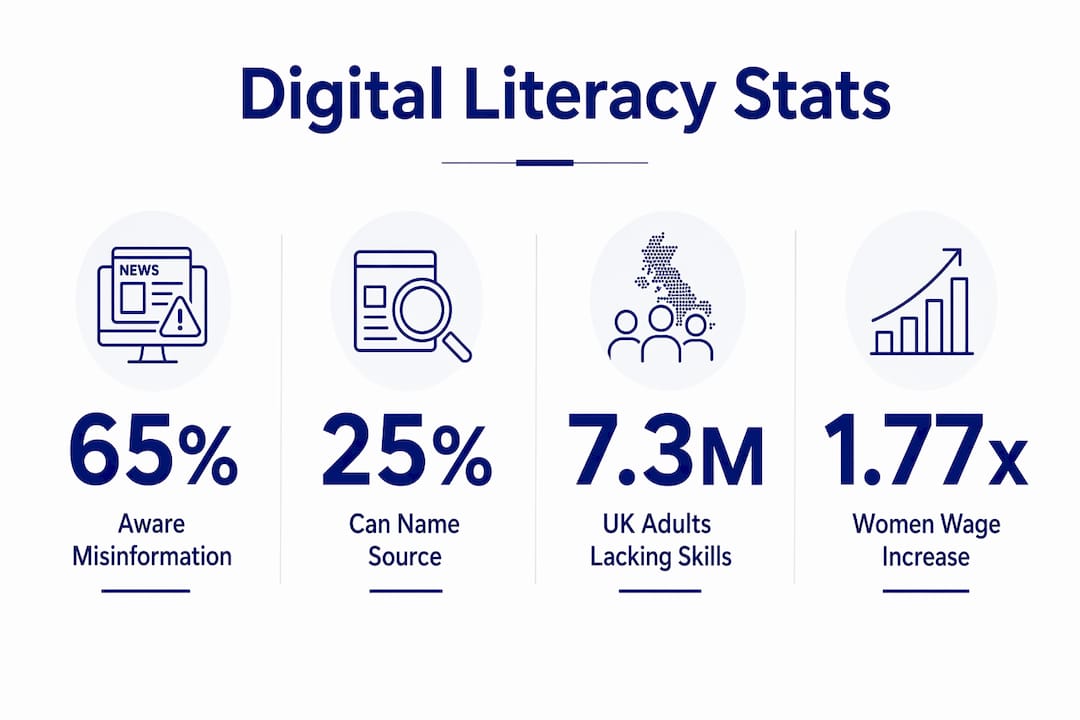
The knowledge-action gap is stark. Research shows 65% of students are aware of misinformation, yet only 25% can name a credible fact-checking organisation. Awareness without practical skill is almost useless. Knowing that fake news exists does not protect you from sharing it.
AI proliferation makes this worse. Generative AI can produce convincing text, images, and audio that mimic trusted sources. The critical literacy skills needed to assess AI-driven manipulation go well beyond basic media awareness. You need to understand system bias, source tracing, and the commercial incentives that shape what platforms show you.
Democratic participation is directly affected. When citizens cannot distinguish credible policy information from coordinated disinformation, electoral decisions suffer. Digital literacy is, at its core, a civic skill. The ethical and civic dimensions of digital competence, including privacy rights, online safety, and responsible participation, are now inseparable from the technical ones. You can read more about how these trends are reshaping our online world in Cybercompassconsulting’s 2026 digital safety trends guide.
How does digital literacy affect individual opportunities and society?
The economic cost of poor digital literacy is concrete. 7.3 million employed adults in the UK lack fundamental digital skills, costing the economy £63 billion every year. That figure represents lost productivity, missed employment opportunities, and a widening gap between those who can participate in the digital economy and those who cannot.
The benefits of digital skills are not evenly distributed. Research from China found that women’s wages rise 1.77 times faster when they develop digital literacy compared to those without it. Digital competence actively narrows gender wage gaps. That is a powerful argument for treating digital literacy as an equity issue, not just a workforce one.
Digital overload compounds inequality further. Low-skilled users experience digital tools as a source of stress and boundary erosion. Skilled users, by contrast, use the same tools to save time and grow income. The gap between these two groups widens as technology accelerates. The impact of digital literacy on individual outcomes is not neutral. It compounds advantage for those who have it and deepens disadvantage for those who do not.
The social picture is equally concerning. Families navigating online safety together face real risks when digital skills are uneven across generations. Children may be technically fluent but critically naive. Parents may be critically aware but technically behind. Neither profile is safe on its own.
What challenges exist in developing digital literacy skills?
The biggest myth in digital education is the “digital native” assumption. Growing up with a smartphone does not produce deep digital literacy. Australian Year 10 students recorded proficiency rates of just 37% in 2025 tests, despite spending more time online than any previous generation. Device access and digital competence are not the same thing.
A second challenge is the illusion of control. Many people believe they manage their online experience actively. In reality, passive consumption patterns driven by algorithmic curation shape most of what people see, read, and believe. You are not browsing freely. You are being served content selected to maximise your engagement, often at the cost of accuracy or balance.
Here are four practical steps to build stronger digital literacy:
Practise lateral searching. When you encounter a claim, open a new tab and search for independent sources before accepting it. Do not verify a claim using the same site that made it.
Use reverse image search. Drag any suspicious image into Google Images or TinEye to check its origin and context. This single habit catches a surprising number of manipulated visuals.
Trace sources upstream. Find the original study, report, or statement behind a headline. Summaries distort. Primary sources clarify.
Audit your feed. Periodically search for topics you care about outside your usual platforms. Compare what you find. The difference reveals your algorithmic bubble.
Pro Tip: Treat every viral claim as a question, not a fact. The three seconds it takes to check a source is the most valuable digital habit you can build.
Formal education matters here too. Teacher skill levels critically influence student digital literacy outcomes. Schools that treat digital literacy as a standalone subject rather than embedding it across the curriculum produce students who can pass a test but not apply the skills in real life.
How can digital literacy improve your daily digital life?
Applying digital literacy daily is less about grand gestures and more about consistent small habits. The role of digital habits in safety is well documented. Habits compound. A small daily practice of source verification builds into a reliable critical instinct over months.
Responsible digital communication starts with pausing before you share. Ask whether you have verified the claim, whether sharing serves a genuine purpose, and whether the content could harm someone. These three questions take seconds but prevent a great deal of damage.
Cyber hygiene is a practical expression of digital literacy. Strong, unique passwords, two-factor authentication, and regular privacy setting reviews are not technical luxuries. They are the minimum standard for safe digital participation. Families can build these habits together, which is one reason Cybercompassconsulting’s family digital safety resources focus on shared household practices rather than individual fixes.
Managing digital wellbeing is the final piece. Recognising when screen time is eroding sleep, focus, or relationships is itself a digital literacy skill. The ability to set boundaries with technology, to choose when to engage and when to step back, reflects the kind of self-awareness that separates reactive digital use from intentional digital living.
Key takeaways
Digital literacy is the single most transferable skill for navigating modern life safely, economically, and with genuine critical independence.
Point | Details |
Six competence areas | Digital literacy spans technology, evaluation, creation, communication, computational thinking, and ethics. |
Economic stakes are real | A skills gap costs the UK economy £63 billion annually, showing the personal and national cost of low digital competence. |
AI raises the bar | Generative AI and misinformation require critical evaluation skills that go well beyond basic device use. |
Digital natives are a myth | Only 37% of Australian Year 10 students tested as proficient in 2025, despite growing up online. |
Daily habits build competence | Lateral searching, source tracing, and feed audits are practical skills anyone can develop immediately. |
Why I think we are still underestimating this problem
I have spent years working with families, schools, and organisations on digital safety, and the pattern I keep seeing is the same. People treat digital literacy as a technical problem with a technical solution. Install a filter. Run a one-hour workshop. Tick the box. Then move on.
That approach misses the point entirely. The real challenge is behavioural and cultural. It is about how we think when we are online, not just what tools we use. A teenager who can bypass any content filter but cannot evaluate a manipulative YouTube video is not digitally literate. A professional who uses encrypted email but shares unverified health claims on Facebook has a gap that no software can close.
What concerns me most right now is the speed of AI-generated content. We are entering a period where the volume of plausible-sounding misinformation will exceed any individual’s capacity to manually verify it. The only reliable defence is a deeply ingrained habit of scepticism and a genuine understanding of how these systems work. That takes time to build. We needed to start years ago.
The good news is that critical digital literacy is teachable. It responds to practice. Every time you pause before sharing, every time you trace a claim to its source, you are building a mental habit that becomes faster and more automatic. The urgency is real, but so is the capacity for change.
— Jemma
How Cybercompassconsulting supports your digital literacy goals
Cybercompassconsulting works with families, schools, and organisations to build genuine digital competence grounded in behavioural science and real-world practice. The focus is not compliance checklists. It is lasting change in how people think and act online.
Whether you are a parent trying to guide your children safely online, a school leader looking for a structured programme, or an organisation wanting to reduce human error in your digital culture, Cybercompassconsulting has a path for you. The Cyber Wellness School Programme delivers evidence-based digital literacy and safety education directly to school communities. For individuals and organisations ready to build a structured plan, the cyber wellness planning service creates a personalised roadmap for safer, more confident digital living.
FAQ
What is digital literacy, exactly?
Digital literacy is the ability to access, evaluate, create, and communicate information using digital technologies responsibly and critically. It covers six competence areas including technological skills, content evaluation, and ethical responsibility.
Why does digital literacy matter for everyday people?
Poor digital literacy costs individuals real economic and social opportunities. Research links stronger digital skills to higher wages, better employment outcomes, and greater resilience against online manipulation and scams.
Are young people already digitally literate?
Growing up online does not guarantee digital literacy. Only 37% of Australian Year 10 students tested as proficient in 2025, showing that device access and genuine competence are very different things.
How does digital literacy connect to online safety?
Digital literacy underpins every aspect of online safety, from recognising phishing attempts to protecting personal data and evaluating the credibility of health or financial information found online.
How can I improve my digital literacy quickly?
Start with lateral searching: when you encounter a claim, verify it using independent sources before accepting or sharing it. This single habit addresses the most common and costly gap in everyday digital competence.
Recommended
Comments